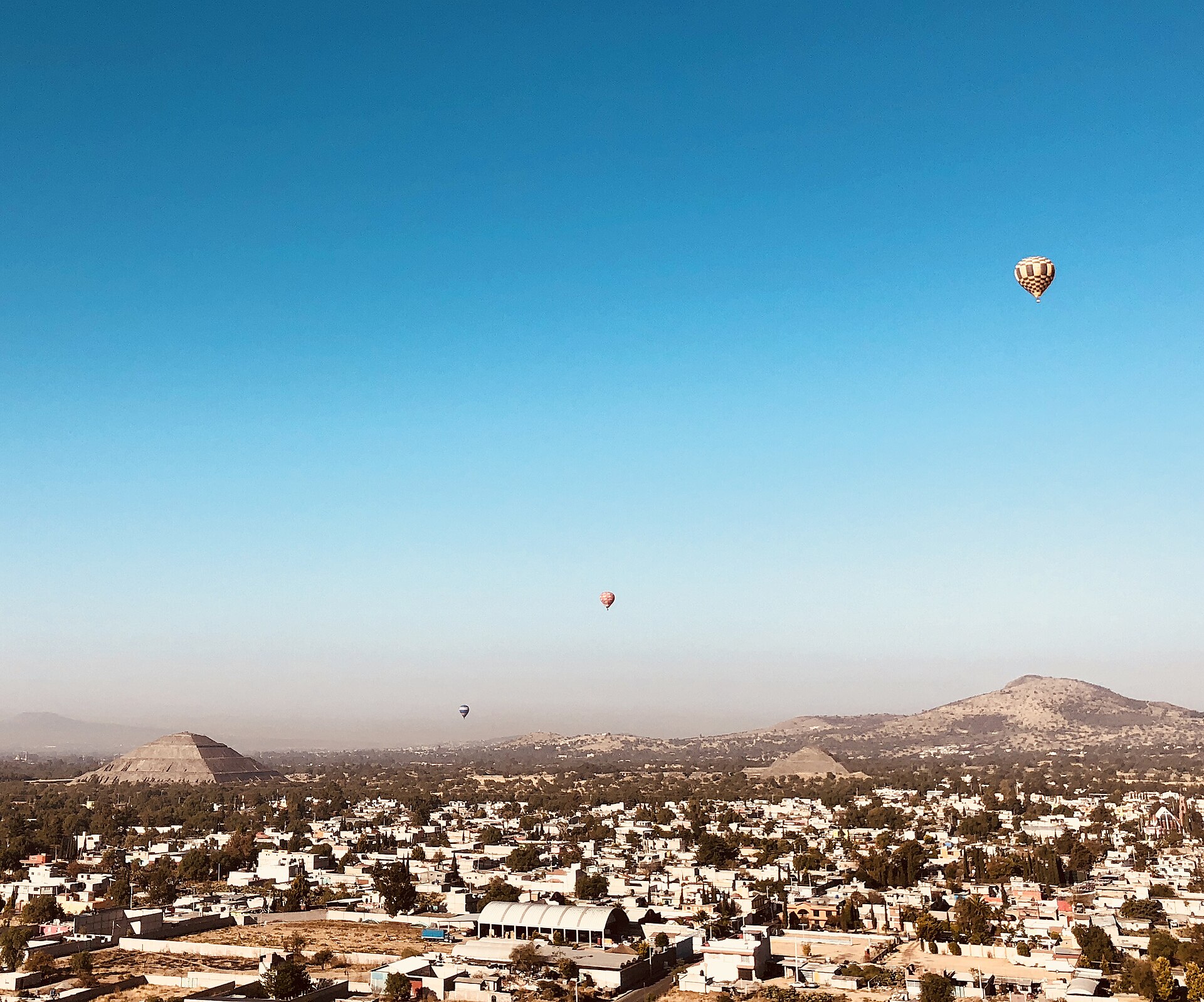
Most photographs of a balloon over Teotihuacan are taken from the ground, looking up at a striped envelope hanging beside the Pyramid of the Sun. From inside the basket the view is different, and more honest. For much of the hour you are looking down at flat roofs, black water tanks, nopal fields and the odd church dome, with the two great pyramids sitting in the middle distance. Whether you drift over them, beside them or nowhere near them depends on what the wind does that morning, and nobody can promise otherwise. That is the first thing to understand before you book a Teotihuacan hot air balloon tour. The second is that the question of who is flying you is not a formality here. It is most of the decision.
This page compares the ways a flight is sold — balloon only, balloon with breakfast, balloon with transport from the city, and the private basket — at the prices operators were publishing in October 2026, with what each leaves out and which kind of traveller it suits. It sets out the checks worth making since the fatal fire of April 2023, what actually happens between the alarm and the landing, how the weather decides everything, and what to do with the day when the flight is cancelled, which it regularly is. For the archaeological site itself, including the gates, the rules and the walking route, the full picture is in our guide to visiting Teotihuacan from Mexico City. This page is about the hour in the air and the morning built around it.
The short answer
- What it costs: a shared flight starts at about 1,990 pesos per person on operators’ own websites (checked October 2026), roughly 115 US dollars at mid-September exchange rates. Packages that add breakfast or transport from Mexico City run from about 2,590 to 3,400 pesos, and a private basket for two started at 3,750 pesos per person on the list we checked.
- What it usually leaves out: entry to the archaeological zone, which is 210 pesos for foreign visitors and 105 for Mexican nationals and residents. It is sold only at the site’s box offices and through INAH’s own channel.
- What to check before you pay: the balloon’s Mexican registration, the pilot’s licence from the AFAC (Mexico’s federal civil aviation agency), what the insurance covers, and the name of the company that actually operates the balloon. The balloon in the 2023 fire had no Mexican registration and no AFAC authorisation.
- What usually goes wrong: wind. Cancellations are routine, and the usual remedy is a free reschedule, not a refund. Book the first morning of your trip, never the last.
- What it is not: a way to get close to the pyramids, let alone climb them. Climbing has been prohibited since 2020, and the flight lands before the site opens at nine.
- Who should skip it: anyone with a single fixed morning for Teotihuacan, anyone who will resent a four o’clock alarm, and anyone for whom 2,000 pesos is two days of eating well. The site is magnificent from the ground for about a tenth of the price.
At a glance: what a flight costs in 2026
Balloon prices are not regulated or published centrally, so the only honest way to quote them is from an operator’s own list, with a date. The table below is one company’s published price list, Teotihuacan Balloons, as it stood on 3 October 2026. It is a representative list rather than a recommendation: other operator websites checked the same week advertised shared flights from about 1,990 to 2,100 pesos and private flights from about 3,750 pesos per person, with decorated proposal packages that add photography and private transfers running past 15,000.
| What you buy | Per person (MXN) | Listed as included | Not listed |
|---|---|---|---|
| Shared flight, meet at the launch field | 1,990 | Flight of roughly 45–60 minutes, pilot, insurance, a toast | Transport, breakfast, site entry |
| “Traditional” shared flight | 2,300 | As above, with a sparkling-wine toast | Transport, breakfast, site entry |
| Shared flight with breakfast at La Gruta | 2,590 | Flight, breakfast, pilot, insurance | Transport, site entry |
| Shared flight with shared transport from Mexico City | 3,300 | Flight, round-trip shared van from the city, insurance, toast | Breakfast, site entry |
| Shared flight with private transport | 3,400 | Flight, private round-trip transfer, insurance, toast | Breakfast, site entry |
| Private basket, two people maximum | 3,750 | Your own balloon and pilot, insurance, a sparkling-wine toast | Transport, breakfast, site entry |
Two things jump out of that list. The first is how small the gap is between the shared van and a private car: on these prices a private transfer costs 100 pesos more per person than a seat in the shared van, which for a family or a group of friends is the cheapest flexibility you will buy all trip. The second is that the private basket costs nearly double the basic shared flight for the same hour in the same sky.
Now add the rest of the morning. A couple taking the 3,300-peso package with shared transport and paying foreign-visitor entry to the site spends 7,020 pesos between them (two seats at 3,300, two tickets at 210), or a little over 400 US dollars at September’s rate, before breakfast and before tipping anyone. The same couple taking the bus to the site and walking it from opening time would spend well under a tenth of that. Neither choice is wrong. Just make it knowing the numbers.
The ways to buy a flight, and who each one suits
Flight only, meeting at the launch field
The cheapest seat, and the one with the hidden cost. You are responsible for being at the launch field before dawn, and from Mexico City that is harder than it sounds. No public bus is a realistic way to make a pre-dawn check-in, so the practical options are your own car, a driver booked for the purpose, or an app ride in the small hours, and any of those can quietly eat the difference between this package and one with transport included. You also need a plan for the rest of the day: getting from wherever you land to the site, and back to the city afterwards.
Where this option comes into its own is if you sleep near the archaeological zone the night before. There are hotels in the towns around the site, and staying in one turns a four o’clock alarm into something much closer to dawn, puts you minutes from the launch field and leaves you at the gates for opening time without another drive. If you are serious about the balloon, this is the single best way to make the morning pleasant rather than an endurance event.
Suits: travellers with a car or a driver, people staying overnight in the valley, and anyone building a slower two-day visit around the site.
Flight with breakfast
The awkward part of any balloon morning is the gap between landing and nine o’clock, when the archaeological zone opens. A package with breakfast fills it. On the list above the breakfast is at La Gruta, a long-established restaurant set inside a natural cave close to the zone, which is the sort of place that sounds like a tourist trap and is mostly just an atmospheric room with a good breakfast in it. Note that this particular package does not include transport, so it pairs naturally with a hotel night nearby or a car of your own.
Suits: people who want the morning to have a middle, and anyone who knows they will be no use at an archaeological site on an empty stomach after a four o’clock start.
Flight with shared transport from Mexico City
The default for first-time visitors without a car, and for good reason: someone else drives at an hour when nobody should. Pickups are in the small hours, often from a central meeting point rather than your door, so check exactly where. The questions that matter are about the other end of the day. What time does the van return to the city, and does it wait while you visit the site? Some packages bring you back after the flight and breakfast; others build in time at the pyramids. If the van leaves before you have walked the Avenue of the Dead, you will be finding your own way home on the public bus, which is easy enough but worth knowing about before rather than after.
Suits: solo travellers and couples on a short trip who want the logistics handled and do not mind a shared schedule.
Flight with private transport
For three or more people this is usually the best buy on the list, because the extra cost per person over the shared van is small and you control the return. You can stay at the site as long as you like, stop for lunch, or skip the souvenir stop that shared tours tend to include. For a family with children who will flag by eleven, the ability to leave when you need to is worth more than the hundred pesos.
Suits: families, groups of friends, and anyone who wants the balloon and the site in one unhurried day.
The private basket
Your own balloon and pilot, two passengers at most on the list we checked, at 3,750 pesos each. It is the obvious choice for a proposal or an anniversary, and photographers like the room to move. Be clear about what “private” means, though. It is your basket, not your sky: on a good morning there will be many other balloons up at the same time, which is half the spectacle anyway. The view is identical to the shared flight. You are paying for elbow room and the absence of strangers.
Suits: couples marking an occasion, photographers, and people who would rather not share a confined space with a dozen others at dawn.
Buying through a tour company, hotel desk or booking platform
A large share of balloon seats are sold by resellers: the big booking platforms, hotel concierges, and the tour agencies in the Centro. That is not a problem in itself, and a reseller can be useful if it bundles the balloon with a guide for the site. But it adds two questions. Which company actually operates the balloon? Ask for the name and check it directly, because the reseller’s brand tells you nothing about the aircraft. And whose cancellation policy applies? The reseller’s terms and the operator’s terms are not always the same, and the one that matters is the one you paid.
What changed after 2023, and the checks that matter
On the morning of 1 April 2023, a balloon carrying passengers caught fire in flight over the Teotihuacan valley. Two passengers died and their 13-year-old daughter was injured. Reporting in the days that followed established that the balloon had no Mexican registration, no entry in the aeronautical register and no authorisation from the AFAC to fly, and the federation of balloon operators at Teotihuacán, FEGAT, said publicly that it did not hold the permit required to operate there.
When the conclusions of the investigation were reported in October 2024, the probable cause was given as deviation from regulations, maintenance and training in the commercial operation of a balloon that was neither authorised nor certified, flying from unregulated facilities. The same reporting noted something more uncomfortable: at the time of the accident the AFAC had no balloon-specific regulation and carried out no routine surveillance of balloon owners in tourist areas. The authority later announced regulatory offices in Teotihuacán and San Martín de las Pirámides. We could not confirm from a primary source how those offices operate today, and we would rather tell you that than imply a level of oversight we cannot verify.
Accidents have not stopped. In March 2026 Mexican newspapers reported a balloon coming down in the Teotihuacan valley with two British tourists injured. We have not seen a published cause for that incident, and it would be wrong to speculate about one. The point is simpler. Balloon flying here is a busy commercial market with uneven standards, and the checks below are the passenger’s part of the safety system.
Five questions to ask before you pay
- What is the balloon’s registration? Every legitimate aircraft in Mexico carries a registration mark beginning with X, and on a balloon it is normally painted on the envelope. Ask which balloon you will be flying in and what its registration is. A serious operator will tell you without fuss, and you can check the envelope at the field.
- Who is the pilot, and what licence do they hold? Balloon pilots are licensed by the AFAC. “Certified pilots” on a website is a claim; a named pilot with a licence is a fact.
- What does the insurance cover, and whose policy is it? The thing that matters is the operator’s own cover for its passengers, not a generic travel policy offered as an add-on at checkout.
- Which company operates the balloon? If you are buying through anyone else, get the operating company’s name and look it up yourself.
- Where do you launch from? Established operators fly from known launch fields with a ground crew and a chase vehicle following by road. A vague meeting point by a highway and a crew of one is a different product, whatever the website says.
Two further notes. Price is a signal. Propane, a trained crew, a chase vehicle, maintenance and insurance cost roughly the same whoever sells the seat, so a flight offered well below the going rate is economising somewhere you cannot see. And ignore the safety league tables that some operators publish ranking their competitors. They are marketing, written by an interested party. The authority on whether a balloon may carry passengers is the AFAC, not a rival’s comparison page.
What happens on the morning
Every operator runs its morning slightly differently, but the shape is consistent enough to plan around.
- The pickup. On packages with transport from the city, expect a pickup somewhere between four and five in the morning, depending on the season and where you are staying. At that hour the drive north-east out of the city takes about an hour.
- The launch field. Coffee, check-in, a safety briefing and, in most cases, some paperwork. Then you watch the crew lay out the envelope, fill it with cold air from large fans and bring it upright with the burners. This part is genuinely worth arriving on time for, and it is cold.
- Boarding. You climb into the basket over a wicker wall roughly at waist height, usually using footholds built into the side. There are no seats. You stand for the whole flight.
- The flight. Operators quote about 45 to 60 minutes in the air. The pilot controls height, not direction, and steers by finding different wind directions at different altitudes. That is why the route over the pyramids cannot be promised.
- The landing. Wherever the wind and the fields allow. The pilot will brief you on a landing position before you come down. Some landings are gentle, some are a firm bump, and on a breezy morning the basket can tip and drag a short distance. The chase crew arrives by road to pack up.
- Afterwards. A toast, a flight certificate on some packages, then breakfast or the drive to the site. The archaeological zone opens at 09:00.
Launch times follow the sun. At Teotihuacan’s latitude sunrise comes at roughly 06:00 in June, around 06:30 in October and as late as about 07:15 in mid-January. Mexico stopped changing its clocks for summer time in 2022, so older guides that quote different times for the same month are out by an hour. Your operator’s meeting time is the one that counts, and it will move with the season.
One small thing nobody mentions: there are no toilets in a balloon. Use the facilities at the launch field, and go easy on the coffee.
Weather, season and the cancellation question
Balloons need calm air, and wind is the usual reason flights are cancelled. The decision is the pilot’s, often made at the field after a test balloon has gone up, and it can come very late. When a pilot cancels for weather, that is the safety system working. Never pressure a pilot to fly, and be wary of any operator who seems eager to go when everyone else is packing up.
The seasons matter less than the morning, but they do matter. Using the long-term averages for Mexico City’s reference station at Tacubaya (the valley around Teotihuacan is not identical, but the pattern holds):
| Season | Months | Average rainfall | What it means for a dawn flight |
|---|---|---|---|
| Dry season | November to April | 5 to 24 mm a month | Clearest skies, coldest dawns, the most reliable flying. Haze can sit on the horizon on still mornings. |
| Turn of the season | May and October | 59 mm in May, 71 mm in October | Mixed. Many good mornings, more uncertainty. October mornings often clear after a wet night. |
| Rainy season | June to September | 132 to 176 mm a month | Storms usually build in the afternoon, so many mornings still fly, but low cloud and unsettled air cancel more of them. |
Dress for the dawn, not the day. In December and January the average overnight low in the city is 8.5 °C, and an open field before sunrise can feel colder than that. The burner throws heat in short bursts overhead, which is pleasant on the top of your head and does nothing for your hands. Wear layers you can strip off later, a hat, and closed shoes that can cope with a ploughed field. Everything you take off has to be carried around an archaeological site that does not allow backpacks, so keep the layers light.
Reading the cancellation policy
The operator whose prices are quoted above says that if the weather does not allow a safe flight, the tour is rescheduled free of charge. That is typical, and it is fair. It is also worthless if you are flying home the next day. Before you pay, find out:
- whether a weather cancellation is rescheduled, refunded, or either at your choice;
- how much notice you get, and whether you are told at your hotel or only at the field;
- what happens to the transport and breakfast on a cancelled morning;
- whether a cancellation for any reason other than weather is treated differently.
Get the answers in writing; a WhatsApp message counts. Then book the flight for the first available morning of your trip, so that a cancellation can roll forward to another day instead of evaporating. Paying by card rather than by cash deposit to a phone number gives you some recourse if a promised refund never arrives.
Access, health and who should not fly
A balloon flight is gentle in the air and physical at both ends. Before booking, be honest about the following.
- Getting in and out. Climbing over the basket wall needs some agility, you stand for the whole flight, and you need to be able to hold a landing position and cope with a firm bump. If you use a wheelchair or have limited mobility, ask the operator directly what they can do. Do not assume either way.
- Pregnancy. Ask the operator and your own doctor before you book. Many balloon operators around the world will not carry pregnant passengers.
- Children. Operators set their own minimum ages, and small children may not be able to see over the side of the basket. Ask before you pay rather than at the field.
- Weight. Some operators ask for passengers’ weights when you book so they can load the basket safely, and some set an upper limit. Answer honestly; it is a safety question, not a judgement.
- Heart, lung and back conditions. Mexico City sits at about 2,240 metres and you will go higher in the balloon. Most visitors adjust to the altitude within a day or three, but if you have a condition that might be affected, talk to your own doctor before the trip. This page cannot advise you on that.
- Fear of heights. People who dislike towers sometimes find a balloon easier than expected, because the basket moves with the wind and there is almost no breeze or sense of speed. Others do not. Only you know which you are.
- Cameras and phones. Use a wrist strap. Anything dropped over the side is gone. Do not bring a drone: INAH prohibits them at the archaeological zone.
After you land: the site itself
Most balloon mornings end at the archaeological zone, and this is where the access rules matter, because several of them catch balloon passengers in particular.
- Entry is almost never in the balloon price. It is 210 pesos for foreign visitors and 105 for Mexican nationals and residents under the INAH tariff in force since 1 January 2026. Under-13s, and students and teachers with valid ID, enter free.
- Sunday is not free for tourists. Free Sunday entry now applies only to Mexican nationals and legal residents. Visitors on a tourist permit pay full price on Sundays, whatever an older guide or a package description says.
- Buy tickets only at the site’s box offices or through INAH’s own channel. Not from someone at the roadside, and not as an inflated add-on to a balloon package unless the operator can show you it is a genuine INAH ticket.
- You cannot climb the pyramids. Ascent of the Pyramid of the Sun has been prohibited since 2020, and the Pyramid of the Moon is closed too. Visitors stay on the plazas and off the platforms. If a balloon package still promises a climb after the flight, its description is years out of date, and that tells you something about how carefully the rest of it is maintained.
- No backpacks or large bags. INAH’s list of prohibited items includes backpacks, luggage and large bags, as well as drones, chairs, speakers and umbrellas of the beach kind. After a cold dawn this is the rule that bites: the bag full of layers has to stay in the vehicle or be small enough to pass.
- It is open on Mondays, 09:00 to 17:00 every day, with the site museums closing at 16:30. Since almost every museum in Mexico City closes on Mondays, a balloon-and-pyramids Monday is one of the smartest days you can plan.
A route that works after a flight
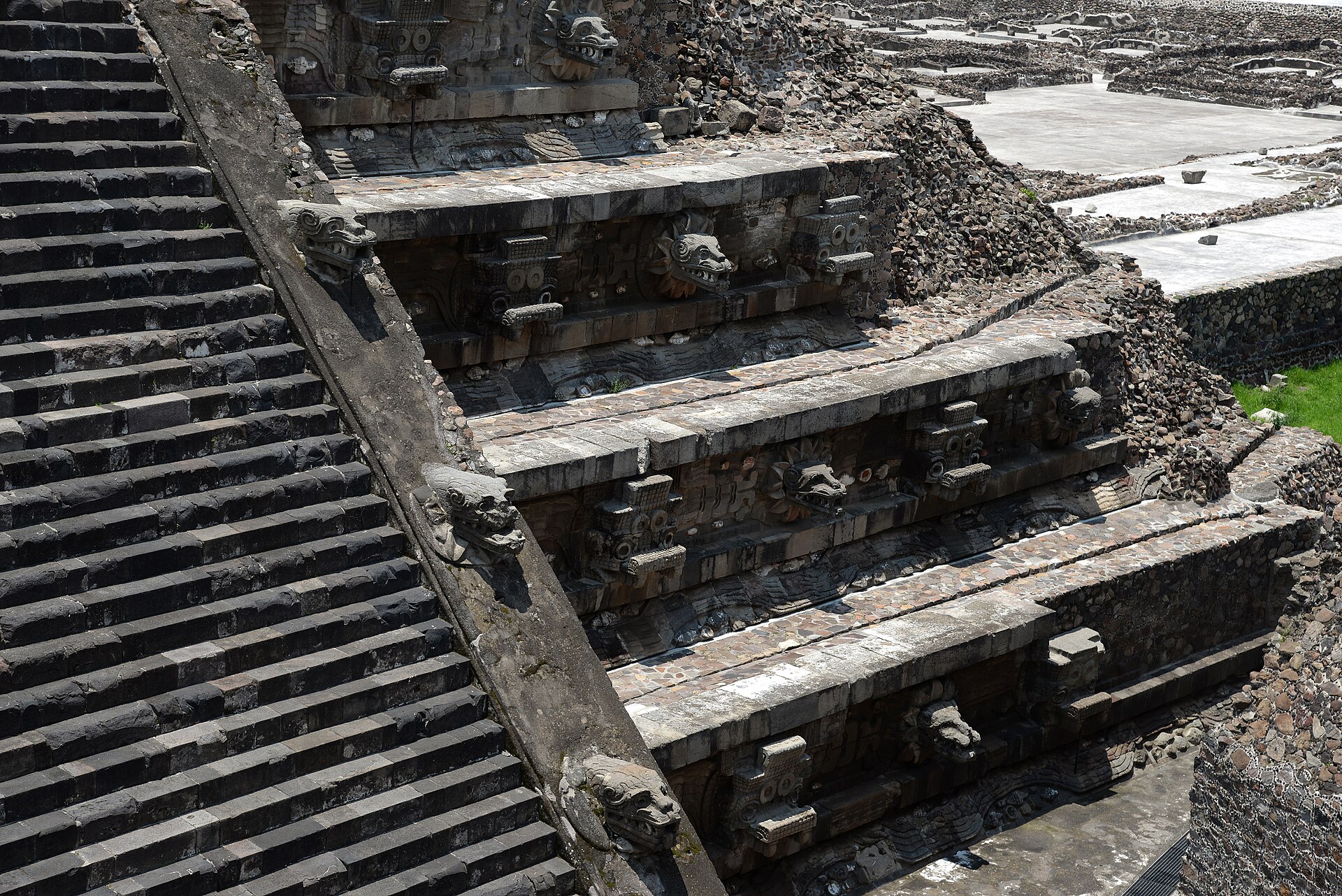
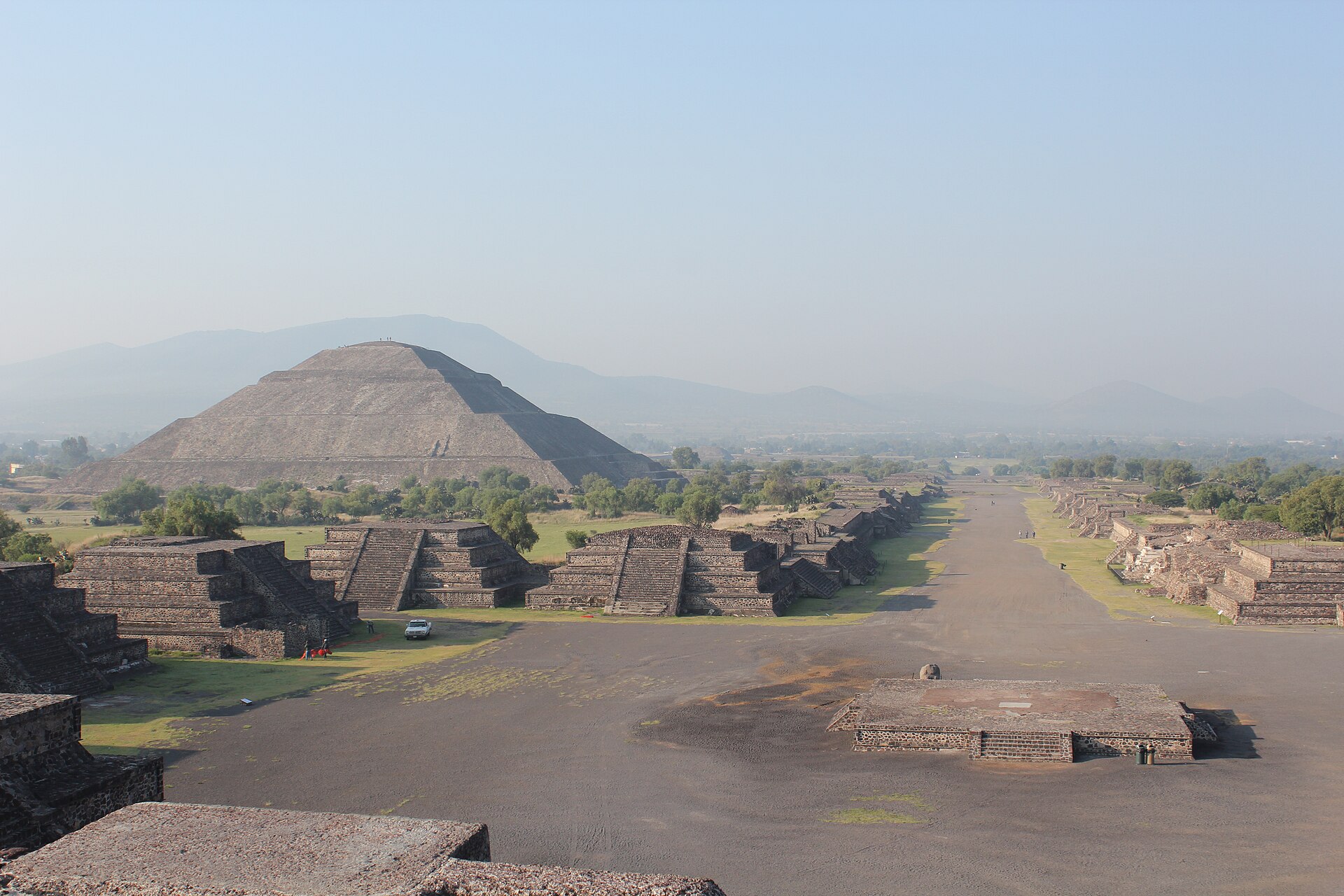
You will have been awake since before four, so do not try to see everything. A sensible shape is to start at the southern end at the Ciudadela, where the carved heads of the Temple of the Feathered Serpent are the finest sculpture on the site and the thing a balloon cannot show you. Then walk north along the Avenue of the Dead, about two kilometres end to end, past the Pyramid of the Sun to the Plaza of the Moon, which gives the classic view back down the avenue. If your transport is meeting you, agree the gate in advance, because the site is long and the gates are far apart. Our Teotihuacan guide covers the gates, the site museums and the murals most visitors walk straight past.
The real constraint is the sun. The site is vast, exposed and almost shadeless, and by late morning in the dry months it is genuinely punishing. After a balloon you have a natural advantage: you are there at opening, before the coach parties. Use it. Carry water, wear a hat, and plan to be heading home by early afternoon.
Getting back to the city
If you bought a package with transport, confirm the return time and meeting point before you walk into the site, not after. If you are making your own way, the public buses back to Mexico City’s Terminal del Norte run from the area around the site’s gates, and from the terminal Metro Line 5 takes you back into the network for 5 pesos. The getting around guide explains the Metro, the Movilidad Integrada card and how the city’s transport fits together.
If the flight is cancelled: the fallback plan
Assume this will happen to you and plan the morning so that it does not matter much.
- You are already there, so use it. A cancelled flight still leaves you in the valley at dawn, two or three hours before the site opens. Have breakfast, then be at the gates for nine and enjoy the empty Avenue of the Dead. This is one reason the packages with breakfast or a private car are better value than they look: they leave you with a morning rather than a stranded van.
- Rebook before you leave the field. Get the new date and time in writing on the spot. If the operator is flying again the next morning and you are free, take it.
- Know in advance what the shared van does. On some packages a cancelled flight means the van still takes you to the site; on others it means an early return to the city. Ask when you book.
- If you cannot reschedule, ask for the refund in writing, referring to the policy you were given. This is where paying by card helps.
- Accept that there is no real substitute. Nothing else near Mexico City gives you that dawn view of the valley. The best ground-level view at Teotihuacan is from the Plaza of the Moon, looking back down the avenue. In the city, the 44th-floor mirador of the Torre Latinoamericana (220 pesos, open daily 09:00 to 22:00) is the best consolation for a view from height, though it is a different thing entirely.
Is a balloon flight over Teotihuacan worth it?
For the right person, yes, and it is one of the few genuinely memorable paid experiences around Mexico City. Rising out of a cold field as the sun comes up over the valley, with the pyramids catching the first light and the sky filling with other balloons, is a sight people talk about for years. Nothing on the ground gives you the sense of how the ancient city sat in its landscape, or how much of that landscape is now town.
But it is expensive by the standards of this city, it costs you a night’s sleep, and it is the least reliable thing you can book here. The archaeology is on the ground, and you will see it better on foot at nine than from the air at seven. If the flight would mean squeezing Teotihuacan into a single fixed morning with no room for a cancellation, you are better off spending the money elsewhere and walking the site properly.
It is worth it if:
- you have at least one spare morning, so a cancellation can roll forward;
- the cost is comfortable rather than a stretch;
- you want the landscape and the sunrise as much as the pyramids themselves;
- you are happy to have done the most memorable thing of the day by eight in the morning.
Skip it if:
- you have one fixed day for Teotihuacan and nothing else will do;
- you are travelling with young children below an operator’s minimum age, or with anyone who would struggle to climb into a basket;
- a four o’clock start would ruin the archaeology for you;
- 2,000 pesos or more per person would be better spent on a guide for the site, a good meal and a second day out.
How to book it, in order
- Pick the morning first. The earliest free morning of your stay, ideally with another free morning after it. A Monday works especially well, because the site is open and the city’s museums are not.
- Choose the package by how you will get there, not by the headline price. If you have no car and are not staying nearby, compare the transport packages, and look hard at the private-transfer option if there are three or more of you.
- Book directly with the operator where you can, or find out the operator’s name if you book through someone else.
- Ask the five questions above, about the registration, the pilot’s licence, the insurance, the operating company and the launch field. Note the answers.
- Get the cancellation terms in writing, including what happens to the transport and breakfast.
- Pay by card rather than by a cash deposit or a transfer to a personal account.
- Confirm the night before: the meeting point, the time and a phone number that will answer at four in the morning.
- Pack light: layers you can shed, a hat, closed shoes, a small bag that will pass the site’s rules, ID for any discounts, and some cash for the site, breakfast or the bus home.
Frequently asked questions
How much does a Teotihuacan hot air balloon tour cost?
On operators’ own websites in October 2026, shared flights started at about 1,990 pesos per person. Packages with breakfast or transport from Mexico City ran from about 2,590 to 3,400 pesos, and a private basket for two started at about 3,750 pesos per person. Entry to the archaeological zone, 210 pesos for foreign visitors, is usually extra.
Is it safe to fly in a balloon at Teotihuacan?
Balloon flying has a good safety record where it is properly regulated and run, but the market at Teotihuacan has had serious accidents, including the fatal fire of April 2023 involving a balloon that had no Mexican registration and no authorisation from the AFAC. Ask for the balloon’s registration, the pilot’s AFAC licence and the insurance details before you pay, and be suspicious of prices well below the going rate.
Does the balloon fly over the pyramids?
Sometimes. A balloon goes where the wind takes it, and the pilot can only steer by changing height to find different wind directions. On some mornings the route crosses the archaeological zone; on others you see the pyramids from a distance. Nobody can guarantee the route in advance.
What time do balloon flights start?
Flights are timed around sunrise, which at Teotihuacan comes at roughly 06:00 in June and about 07:15 in mid-January. Packages with transport from Mexico City usually pick up between four and five in the morning. The meeting time your operator gives you is the one that counts.
Is entry to the archaeological site included?
Usually not. Check the package carefully. Entry is 210 pesos for foreign visitors and 105 for Mexican nationals and residents in 2026, sold at the site box offices and through INAH’s own channel. Foreign visitors pay on Sundays too.
What happens if the flight is cancelled?
Most operators reschedule weather cancellations free of charge, and some offer refunds. Find out which applies before you pay, get it in writing, and book the earliest morning of your trip so a cancellation can move to another day.
Can children fly?
Operators set their own minimum ages and some have height or weight rules. Small children may not be able to see over the side of the basket. Ask before booking. Children under 13 enter the archaeological zone itself free.
When is the best time of year for a balloon flight?
The dry season from November to April gives the clearest skies and the most reliable flying, with cold dawns. The rainy months from June to September still have many flyable mornings, because storms usually build in the afternoon, but more flights are cancelled for cloud and unsettled air.
Can I climb the pyramids after the flight?
No. Climbing the Pyramid of the Sun has been prohibited since 2020 and the Pyramid of the Moon is closed to climbing as well. Only INAH can authorise an ascent, and no balloon or tour operator can arrange one.
Can I do this on a Monday?
Yes, and it is one of the best days for it. The archaeological zone is open every day including Mondays, while most museums in Mexico City are closed.
Related Mexico City Guides
- Teotihuacan from Mexico City: the complete guide to the site, including the gates, the rules, transport, a walking route and the murals most people miss.
- Day trips from Mexico City: every realistic day out compared, with the travel advisory for each destination state.
- When to visit Mexico City: the climate normals month by month, and what the rainy season really means for your plans.
- Mexico City costs: dated prices for food, transport and admissions, and how to budget a trip.
- Mexico City safety: advisories by state, help numbers and the practical precautions that matter.
- Mexico City itineraries: how to fit Teotihuacan into a three-, five- or seven-day trip.
- Mexico City with kids: what works at which age, including day trips with children.
Sources and verification
- Balloon prices and inclusions: published package list of Teotihuacan Balloons (shared flight 1,990; traditional 2,300; flight with breakfast at La Gruta 2,590; flight with shared transport from Mexico City 3,300; flight with private transport 3,400; private flight, two people maximum, 3,750; all per person, MXN), with the operator’s statements on flight length (about 45–60 minutes), AFAC-certified pilots, included insurance and free rescheduling for weather. Checked 3 October 2026. Other operators’ published starting prices checked the same week. Prices are operator-set and change without notice.
- The April 2023 accident: Mexican press reporting of 1–3 April 2023 (including Infobae and ABC Noticias) on the fire, the casualties, the balloon’s lack of Mexican registration, aeronautical registration and AFAC authorisation, and FEGAT’s statement on permits; AFAC’s announcement of an investigation. Checked October 2026.
- The investigation’s conclusions and the regulatory gap: El Financiero, 28 October 2024, reporting the probable cause and the absence at the time of balloon-specific regulation and routine surveillance; reporting of AFAC’s announced offices in Teotihuacán and San Martín de las Pirámides. Checked October 2026. We could not verify how those offices operate in 2026.
- The March 2026 incident: El Informador (16 March 2026) and Expreso reporting a balloon coming down in the Teotihuacan valley with two British tourists injured. No published cause seen. Checked October 2026.
- Archaeological zone admission and rules: INAH Category I tariff of 210 pesos for foreign visitors and 105 for nationals and residents from 1 January 2026; free Sunday entry limited to Mexican nationals and legal residents; hours 09:00–17:00 daily with site museums closing at 16:30; climbing prohibited since 2020; prohibited items including drones, backpacks, luggage and large bags. Checked September 2026. INAH revises tariffs each January.
- Climate: Servicio Meteorológico Nacional normals for Ciudad de México (Tacubaya), 1991–2020. Sunrise times calculated for the latitude and longitude of the site on Mexico’s year-round standard time.
- Exchange rate: approximately 17.17 pesos to the US dollar, mid-September 2026.
What this page does not claim. Nobody from this site flew with any of these operators, inspected a balloon or a pilot’s licence, or visited a launch field on the dates published. The price table is one operator’s published list, quoted because it is representative and dated, not because we recommend that company; we ran no survey of every operator and no price comparison beyond the starting prices published online. The safety checks are the questions a passenger can reasonably ask; they are not a substitute for regulation and they cannot guarantee a safe flight. The account of the 2023 accident and the 2026 incident relies on press reporting rather than on the official investigation documents. Operators’ age, weight and health rules were not published on the pages we checked, which is why this page tells you to ask rather than quoting figures.
Photo Credits
View from a balloon towards the Pyramids of the Sun and the Moon: Una mañana en Teotihuacán by Ralibreros112, CC BY-SA 4.0, via Wikimedia Commons.
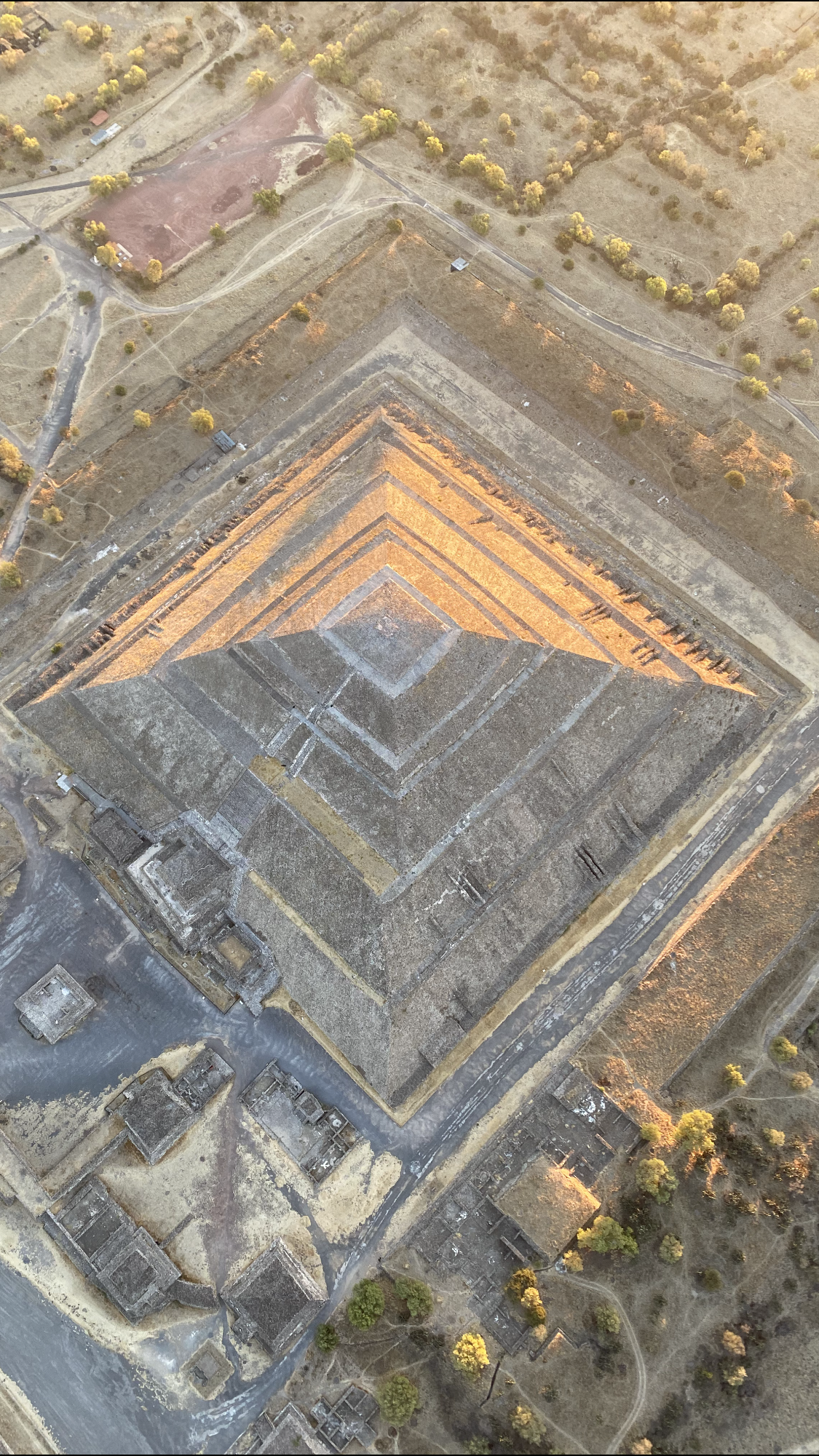
The Pyramid of the Sun from directly above: Vista área de la zona arqueológica de Teotihuacán by AlexCan-am, CC BY-SA 4.0, via Wikimedia Commons.
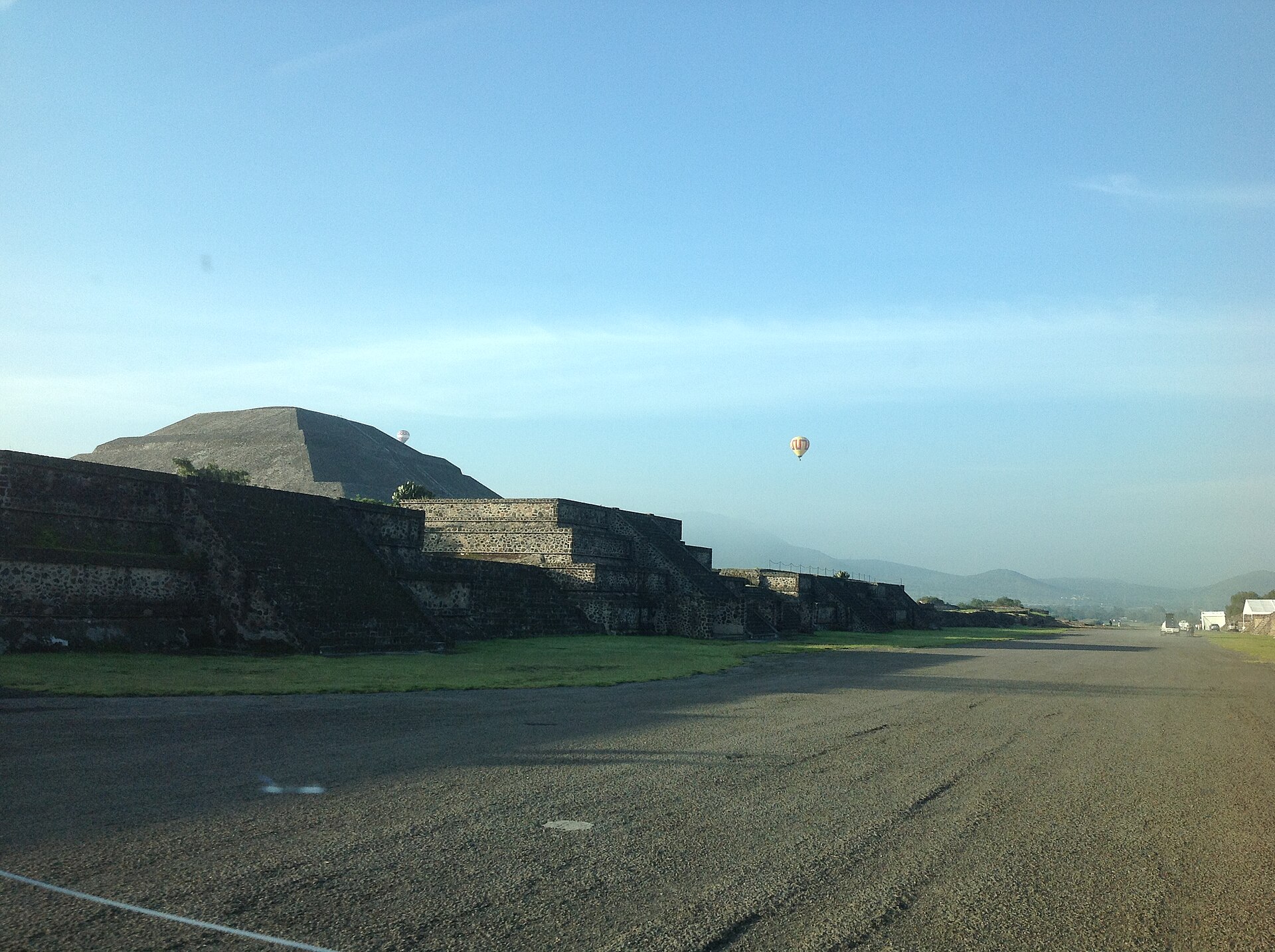
Balloons near the Pyramid of the Sun in the early morning: GLOBOS EN TEOTIHUACAN by Verasino, CC BY-SA 4.0, via Wikimedia Commons.
The Temple of the Feathered Serpent and the view from the Pyramid of the Moon are credited on their original appearance in this site’s media library.