Ask a taxi driver to take you to Condesa and the first thing they will do is ask which part. The city does not think in districts; it thinks in colonias, several hundred of them, and the ones worth a visitor’s time sit in a rough diagonal band about twelve kilometres long, running from the Zócalo in the northeast down to San Ángel in the southwest. Choosing between mexico city neighborhoods to visit is less about picking a winner than about understanding that band: what each colonia was built for, what survived the 1985 earthquake, who lives there now, and how long it actually takes to get from one to the next when the Viaducto is jammed.
The short answer: which colonia suits which traveler
If you have three days and no strong preferences: base yourself in Roma Norte or Juárez, walk the Centro Histórico on day one, and use the Metro for everything south of Chapultepec. That single sentence covers most first trips. Here is the longer version.
| Colonia | Best for | Character | Nearest Metro / Metrobús | From the Zócalo |
|---|---|---|---|---|
| Centro Histórico | First-timers, history, museums | Dense, loud, monumental; empties at night outside a few streets | Zócalo, Allende, Bellas Artes (L2) | — |
| Roma Norte | Eating, walking, a base | Early-1900s mansions, tree-lined, heavily visited | Insurgentes (L1); Metrobús L1 | ~45 min walk |
| Roma Sur | Markets, lower prices | Quieter, more residential, fewer visitors | Centro Médico (L3/L9) | ~55 min walk |
| Condesa / Hipódromo | Parks, art deco, dogs | Green, low-rise, slow | Chilpancingo, Patriotismo (L9) | ~60 min walk |
| Juárez / Zona Rosa | Nightlife, transport links, Korean food | Mixed, commercial, central | Insurgentes, Sevilla, Cuauhtémoc (L1) | ~35 min walk |
| Polanco | Luxury, fine dining, two big private museums | Wide avenues, moneyed, quiet after 22:00 | Polanco, Auditorio (L7) | Metro, ~30 min |
| Coyoacán | A day out, Frida Kahlo, families | Colonial village swallowed by the city | Coyoacán, Viveros (L3) | Metro, ~35 min |
| San Ángel | Saturdays, art, cobbles | Wealthy, historic, hilly | Metrobús L1 La Bombilla | Metrobús, ~45 min |
| Santa María la Ribera | Second trips, architecture | Faded, genuine, gently reviving | San Cosme (L2) | ~35 min walk |
| Tlatelolco | Modern history, archaeology | Sombre, monumental, residential | Tlatelolco (L3) | ~40 min walk |
Two things that table cannot show. The first is that the colonias in the middle of it — Roma, Condesa, Juárez — are the subject of a live political argument about housing and short-term rentals, which changes how you should behave there rather than whether you should go. The second is that a colonia’s boundary matters more here than in most cities, because rents, policing, transport and even street lighting can change noticeably within two blocks. Both come back below.
How the city is actually organised, and why the address matters
Mexico City is divided into sixteen alcaldías — boroughs — which are themselves subdivided into colonias. Cuauhtémoc alcaldía alone holds Centro Histórico, Roma Norte, Roma Sur, Juárez, Condesa, Doctores, Santa María la Ribera, San Rafael and Tabacalera. Miguel Hidalgo holds Polanco, Tacubaya and most of Bosque de Chapultepec. Coyoacán and Álvaro Obregón hold the southern villages.
A Mexican address puts the colonia after the street and number, and it is worth learning to read, because street names repeat across the city. There is an Avenida Michoacán in Condesa and another in Iztapalapa. Send an address to a driver without the colonia and you may arrive somewhere unhelpful an hour away. When you book anything — a restaurant, a rental, a cooking class — copy the colonia and the five-digit postal code with it.
The distinctions locals draw are real rather than pedantic. Roma Norte and Roma Sur are separated by Avenida Coahuila and feel different. Condesa, Hipódromo and Hipódromo Condesa are three legally distinct colonias that everybody calls “la Condesa” in conversation. Knowing that the famous elliptical avenue sits in Hipódromo rather than Condesa proper will not improve your trip. Knowing that “Condesa” covers about two square kilometres of sometimes quite different streets will.
Centro Histórico: the one everybody starts with, and should
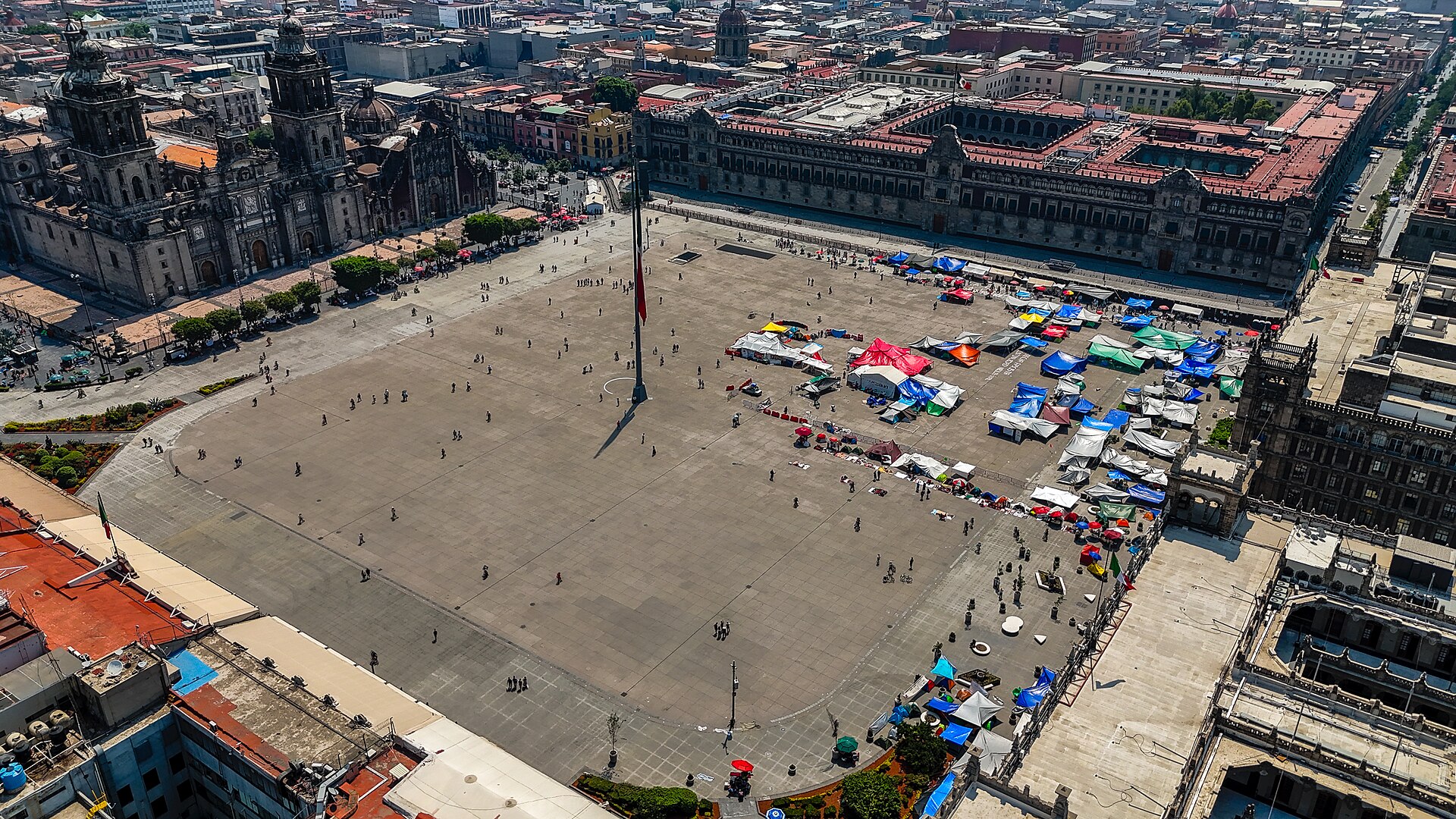
The Centro is a UNESCO World Heritage site — it shares a single inscription with the canals of Xochimilco — and it is the only place in the Americas where you can walk between the Mexica, colonial and modern capitals in twenty minutes. Templo Mayor sits half-excavated beside the Metropolitan Cathedral, which sits on the corner of a square that was the ceremonial heart of Tenochtitlan. Nothing else does this so directly.
The practical shape of the Centro is simple: the Zócalo at the eastern end; Calle Madero, pedestrianised and usually packed, running west from it; the Palacio de Bellas Artes and Alameda Central at the western end; and good streets scattered north and south of that axis. You can walk the spine in twenty-five minutes without stopping. It will take a full day with stops.
The access rules that catch people out
Almost everything in the Centro that charges admission closes on Mondays: Templo Mayor, the Palacio Nacional, the Museo del Palacio de Bellas Artes and most of the smaller museums. The churches, Calle Madero, the markets and the Torre Latinoamericana deck stay open, which is why a Monday in the Centro is a walking day rather than a museum day.
Prices below were checked in September 2026. Mexico’s federal heritage institute, INAH, revises its tariffs every January, so treat any figure older than the most recent January with suspicion — including ours.
| Site | Foreign visitor | Mexican national or resident | Notes |
|---|---|---|---|
| Templo Mayor and site museum | 210 MXN | 105 MXN | Tue–Sun 09:00–17:00 |
| Palacio Nacional (Rivera murals) | Free | Free | Photo ID required over 18; security screening; closes at short notice |
| Museo del Palacio de Bellas Artes | ~90 MXN | ~90 MXN | Run by INBAL, not INAH — free to everyone on Sundays |
| Torre Latinoamericana deck | 220 MXN adult / 170 child 4–11 | Same | Daily 09:00–22:00, including Mondays |
One rule deserves saying loudly, because most English-language guides still have it wrong. Sunday free entry at INAH sites now applies only to Mexican nationals and legal residents. A reform to the Ley Federal de Derechos, published in November 2025 and in force since 1 January 2026, raised the foreign-visitor rate for Category I sites to 210 pesos and restricted the Sunday exemption by nationality. If you are here on a tourist permit you will pay full price on a Sunday, and you will pay it in a longer queue than on a Tuesday. Plan museum days midweek. Our Mexico City museums guide works through which collections justify the new rate.
Where to eat, and when to leave
The Centro is full at lunchtime and thins sharply after dark outside a few well-lit corridors — Madero, the Regina pedestrian street, the Bellas Artes frontage, Calle Motolinía. The Barrio Chino on Dolores is small and mostly geared to Mexican tastes. Plaza Garibaldi, the mariachi square, is genuinely worth an evening but is the classic case for arriving by authorised taxi rather than walking the last eight blocks. For a structured eating route rather than a wander, our Mexico City food guide covers the Centro’s markets and fondas in detail.
Roma Norte and Roma Sur: the default base, for good reasons and one bad one
Roma was laid out in the 1900s as an aspirational suburb for the Porfirian middle class, which is why the streets are wide, the plazas are French and the corner buildings have towers on them. It was badly hit in 1985, left half-abandoned for a decade, then repopulated by people who could afford to rebuild the shells. That sequence explains almost everything about how it looks and feels now.
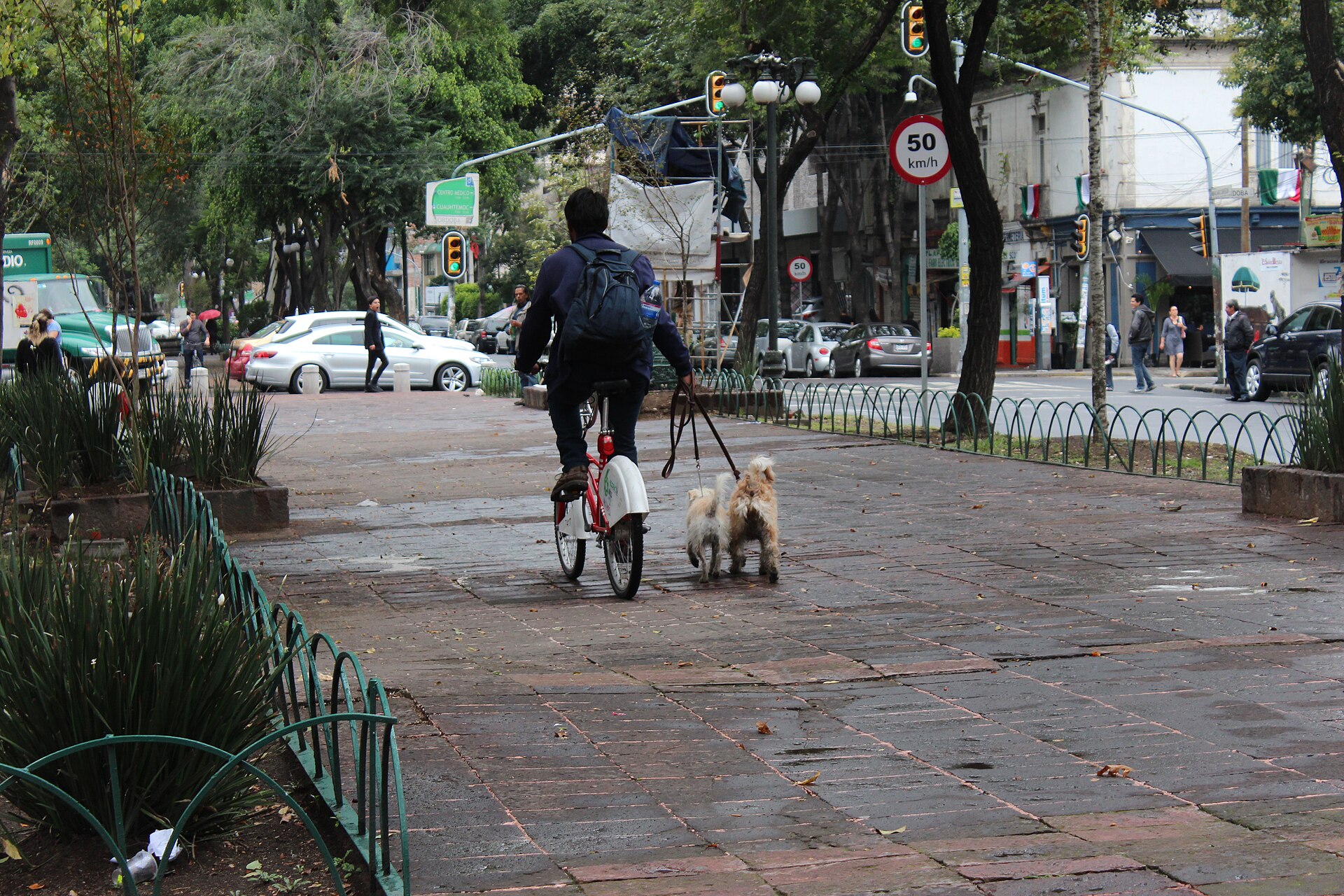
Avenida Álvaro Obregón is the spine: four lanes with a wide planted walkway down the middle, lined with restaurants, bookshops and the cultural centre at Casa Lamm. North of it, Plaza Río de Janeiro — with its copy of Michelangelo’s David — and Plaza Luis Cabrera are the two set-piece squares. Calle Colima, Calle Orizaba and Calle Córdoba hold most of what people come for. Rosetta, on Colima, holds a MICHELIN star in the 2026 Mexico selection; book it weeks out or not at all.
Roma Sur, south of Avenida Coahuila, is where prices drop. Mercado Medellín is the best reason to cross the line: a covered market with a strong South American and Caribbean contingent, open daily and considerably cheaper than the curated food halls to the north.
The bad reason to base yourself in Roma is that you can spend a whole trip among other visitors. It is entirely possible to eat breakfast, lunch and dinner in Roma Norte without hearing Spanish at the next table. If that is not what you flew for, sleep here and eat elsewhere — or sleep in Santa María la Ribera and visit. Our where to stay in Mexico City guide compares the colonias as bases rather than as day trips, including the rental-registry rules that now apply to short stays here.
Condesa and Hipódromo: the green one
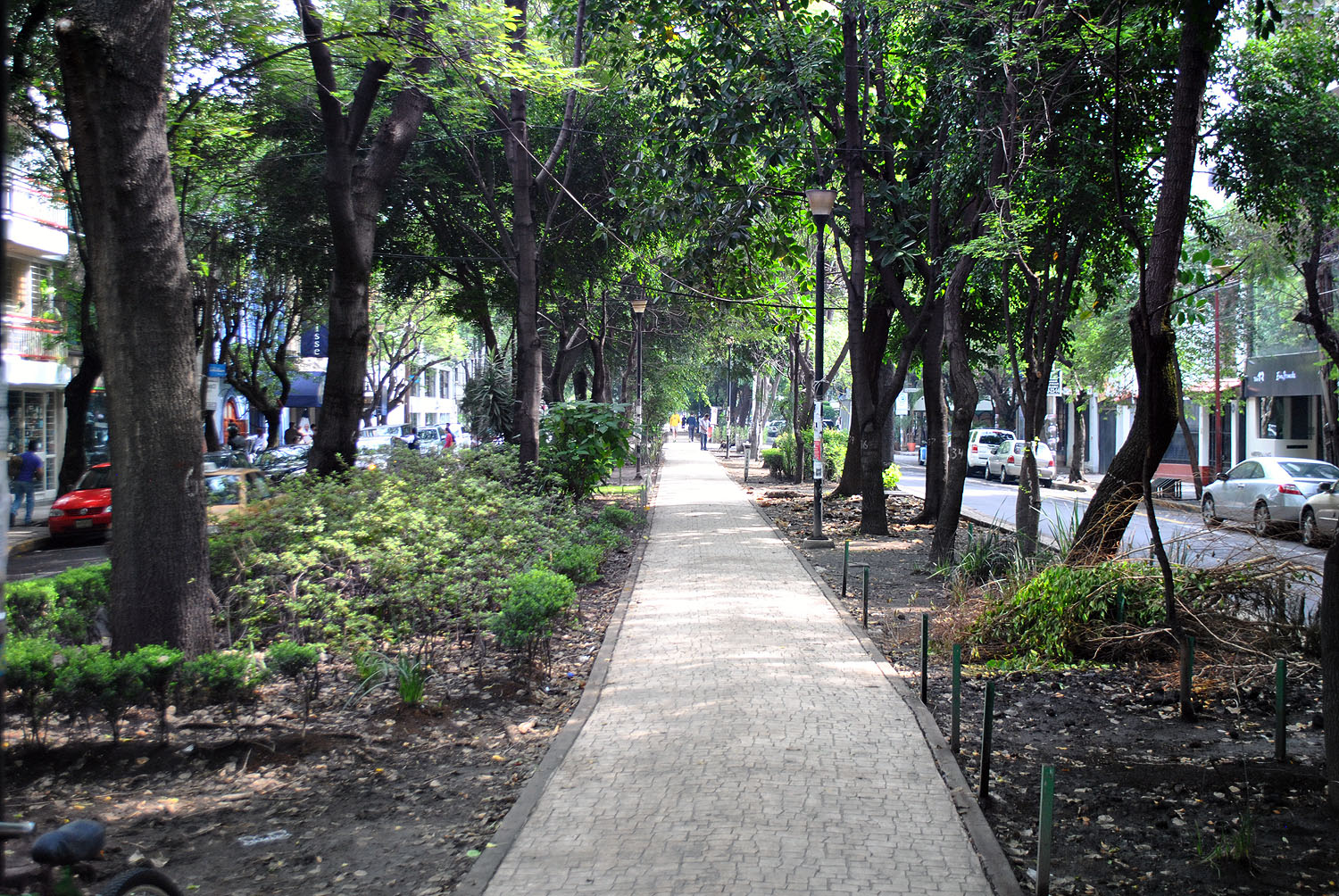
Condesa is the answer when somebody asks which part of Mexico City feels least like a city of twenty-two million. The trees are mature, the buildings rarely exceed six storeys, and a great deal of art deco survives because the area was built out in the 1920s and 1930s and then largely left alone.
Its geometry is worth knowing. Avenida Ámsterdam is a closed ellipse because it follows the perimeter of the Hipódromo de la Condesa, a horse-racing track that operated here until developers bought the land. Walking the full loop takes about half an hour and is one of the most pleasant things you can do in this city for nothing. Inside the ellipse sits Parque México — properly Parque General San Martín — with its deco amphitheatre and its enormous dog population. Parque España is two blocks north.
Avenida Michoacán and Avenida Tamaulipas are the eating and drinking streets. The colonia is walkable end to end in twenty-five minutes, and the Metro is less useful here than elsewhere: Chilpancingo and Patriotismo on Line 9 sit on the southern edge, Juanacatlán on Line 1 on the western, and the middle of Condesa is a ten-minute walk from any of them. This is bike territory.
Ecobici, and why a day pass beats a taxi here
Ecobici, the city bike share, is densest across exactly this band of colonias — Roma, Condesa, Juárez, Polanco, Centro, Del Valle and Narvarte. Tariffs checked September 2026:
| Pass | Price | Included |
|---|---|---|
| 1 day | 134 MXN | Unlimited 45-minute rides for 24 hours |
| 3 days | 263 MXN | Unlimited 45-minute rides |
| 7 days | 441 MXN | Unlimited 45-minute rides |
Overage runs 27 pesos for 46 to 60 minutes, then 54 pesos for each further hour or part of one. The 45-minute clock resets every time you dock, so the system rewards hopping between stations and punishes keeping a bike all afternoon. Registration needs a valid ID — a foreign passport or licence is accepted — and a Visa or Mastercard, and can be done in the app or online before you arrive. The pass can be linked to a Movilidad Integrada transport card.
Two honest caveats. Mexico City traffic is not gentle, and the protected lanes are excellent on some corridors and notional on others. And at 2,240 metres above sea level, a ride that would be nothing at home will have you breathing harder than you expect for the first day or two. That is normal, and for most people it is not dangerous — but take the first day slowly.
Juárez and the Zona Rosa: the practical middle
Juárez is the colonia between Reforma and Roma; the Zona Rosa is the pocket inside it bounded roughly by Reforma, Insurgentes and Chapultepec. It is not beautiful the way Roma is, and it has been through several identities — diplomatic quarter, 1970s nightlife capital, decline, partial revival — but it is the most practically located colonia in the city.
Three things make it worth your attention. The Ángel de la Independencia stands on Reforma at its northern edge and is the city’s default gathering point for celebrations and protests alike. The blocks around Calle Florencia and Hamburgo hold Mexico City’s Korean quarter, with a concentration of restaurants and groceries that has no real equivalent elsewhere in Latin America. And the Zona Rosa is the historic centre of LGBTQ+ nightlife in Mexico, focused on Amberes and Génova — still busy, and still the easiest place in the city to go out without planning ahead.
Transport is the real argument for Juárez. Metro Line 1 runs underneath it with three usable stations; Metrobús Line 1 runs along Insurgentes at its eastern edge; Reforma gives direct road access to Polanco in one direction and the Centro in the other. If you are arriving late or leaving early, our Mexico City airports guide covers how both terminals connect to this side of the city.
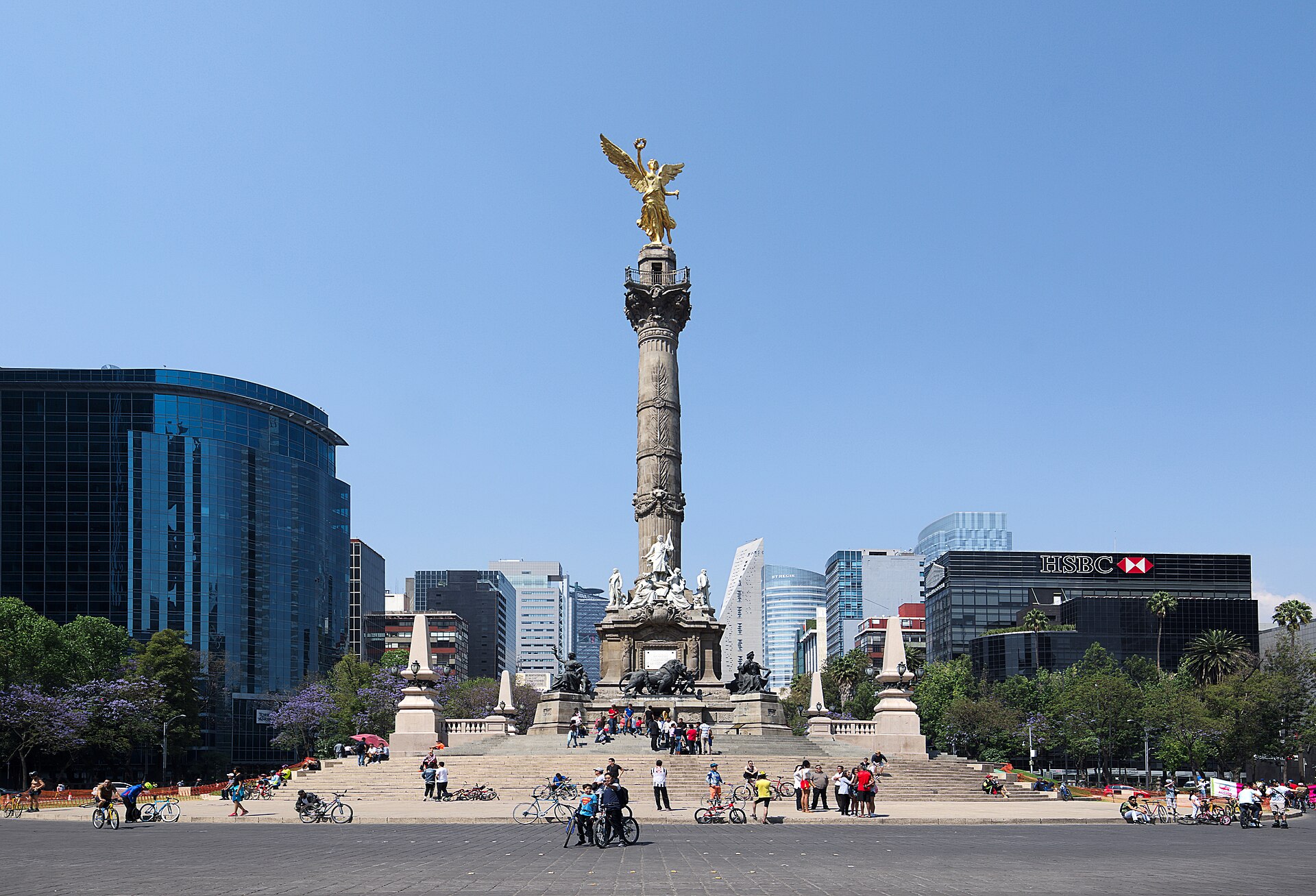
On most Sunday mornings, Paseo de la Reforma closes to cars until early afternoon for Muévete en Bici, with free loan bikes along the route. Walking or cycling the length of Reforma on a Sunday morning, with the Ángel to yourself and no traffic anywhere, is one of the genuinely great free experiences here, and a strong argument for sleeping near it.
Polanco: worth a day, hard to justify as a base
Polanco is where the money is. Avenida Presidente Masaryk is the luxury retail street; the side streets are quiet, gated and heavily patrolled; the restaurant scene is the most decorated in the country. Pujol and Quintonil, both here, both hold two MICHELIN stars in the 2026 Mexico selection — the highest rating awarded anywhere in Mexico, since no restaurant in the country currently holds three.
For a visitor who is not spending four thousand pesos on dinner, the reason to come is Plaza Carso at the colonia’s northern edge. Museo Soumaya, in its silver-tiled twist of a building, is free — no ticket, no booking, typically Tuesday to Sunday from about 10:30 to 18:30. Museo Jumex, across the plaza, holds a much better-curated contemporary collection, charges a modest admission, and is free on Tuesdays. Two serious museums fifty metres apart, one free always and one free one day a week, is an unusually good deal in a colonia otherwise devoted to spending money.
Parque Lincoln, with its mirrored pond and clock tower, is the pleasant middle of Polanco. Metro Line 7 serves the area at Polanco and Auditorio. Do not attempt to walk here from the Centro; it is about ninety minutes through unrewarding blocks, and the Metro does it in half an hour.
Coyoacán: the day trip inside the city
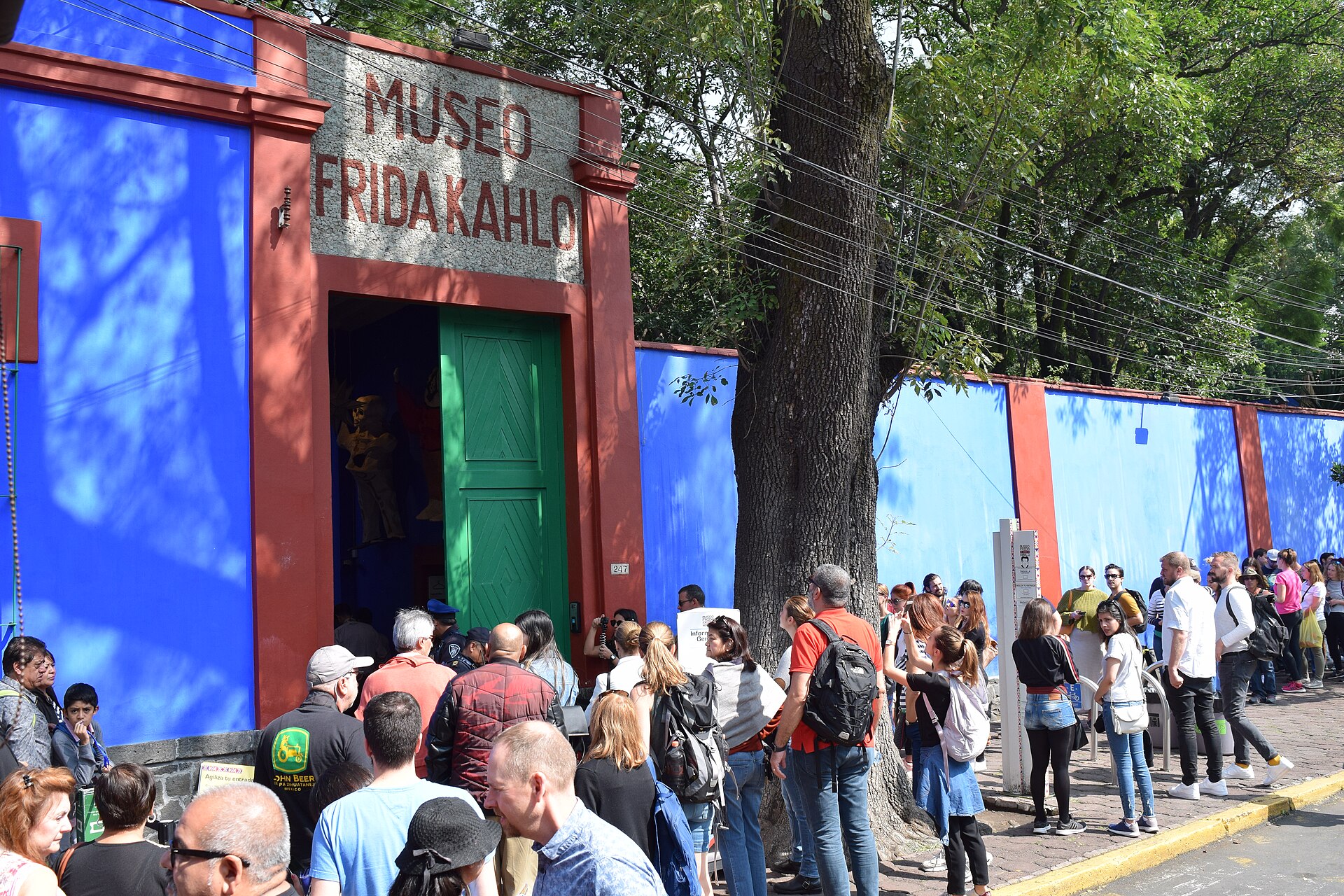
Coyoacán was a separate town until the twentieth century swallowed it, and the centre still reads as one: two adjoining squares, Jardín Centenario and Plaza Hidalgo, a sixteenth-century parish church, cobbled side streets, a covered market. It is the single most enjoyable half-day in Mexico City for anyone tired of traffic.
The obvious draw is the Museo Frida Kahlo — the Casa Azul, on Londres. This is the most important access rule on this page, so here it is plainly: there is no ticket office. Tickets are sold online only, they sell out days ahead in high season, and the museum closes on Mondays. Admission is 320 pesos for foreign visitors and 160 for Mexican nationals, with reduced rates for students, teachers, over-60s and children aged six to twelve, and it includes entry to the Museo Diego Rivera-Anahuacalli further south. Buy before you leave your accommodation, not on the doorstep.
Four blocks away, the Museo Casa de León Trotsky occupies the fortified house where Trotsky was killed in 1940; the bullet holes in the bedroom wall are from an earlier attempt. It is a quieter and stranger visit than the Casa Azul, and it rarely sells out.
The Mercado de Coyoacán is where to eat: tostadas at the stalls in the middle, esquites and churros from the carts out on the plaza afterwards. Viveros de Coyoacán, a working tree nursery turned public park a few blocks north, is free, full of joggers and squirrels, and a good place to sit and do nothing.
Getting there: Metro Line 3 to Coyoacán or to Viveros/Derechos Humanos. Both stations are a twenty to twenty-five minute walk from the historic centre — the Metro does not go to the pretty part, and people are routinely surprised by this. Budget the walk, or take a short taxi from the station.
San Ángel: go on a Saturday, or reconsider
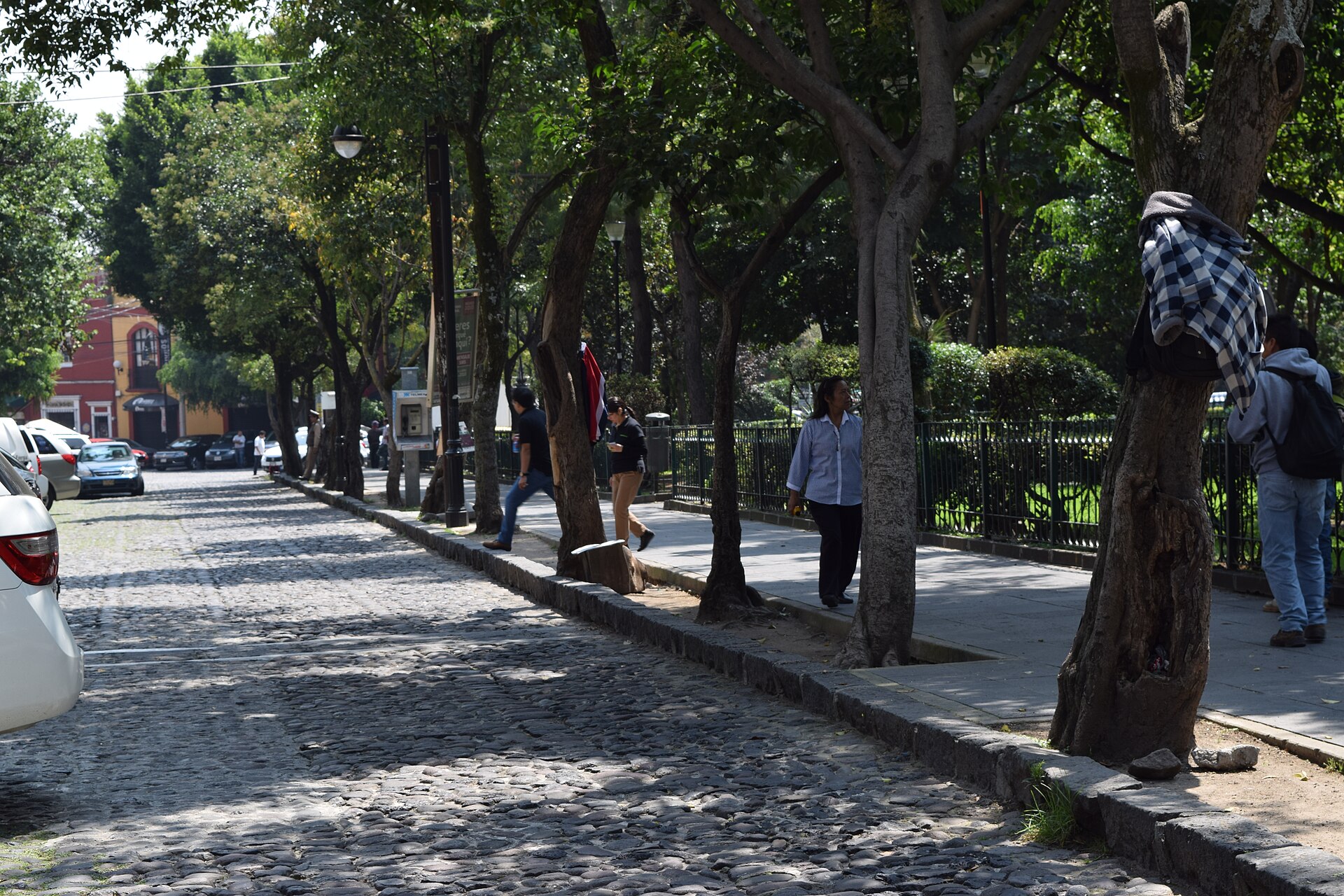
San Ángel is Coyoacán’s wealthier neighbour: another absorbed colonial village, hillier, with better-preserved mansions and worse public transport. The Metro does not reach it. Metrobús Line 1 along Insurgentes is the practical approach — get off at La Bombilla or Dr. Gálvez and walk uphill.
The timing advice is simple. The Bazar del Sábado, an art and crafts market that fills Plaza San Jacinto and the houses around it, runs on Saturdays only. On a Saturday, San Ángel is one of the best afternoons in the city. On a Tuesday it is a handsome but sleepy suburb with a few museums, and you may wonder what the fuss was about.
Beyond the bazaar: the Casa del Risco on the plaza, with its extraordinary fountain assembled from broken porcelain; the Museo Casa Estudio Diego Rivera y Frida Kahlo, two separate functionalist houses joined by a rooftop bridge, designed by Juan O’Gorman in 1931 and closed on Mondays like everything else; and the Ex Convento del Carmen, with mummified remains in the crypt.
Casa Luis Barragán, and the rule that ruins family trips
Northwest of San Ángel, in Colonia Ampliación Daniel Garza on the Tacubaya side of the city, stands Casa Luis Barragán — the architect’s own house, and a UNESCO World Heritage listing in its own right. Two rules, both checked with the house in September 2026:
- Advance online booking is required. The house states that buying tickets in advance through its own site is necessary and that slots are strictly subject to availability. Do not plan to turn up.
- The minimum age is 12, strictly enforced. Almost no guide mentions this, and it has turned a great many families away at the door.
Hours vary day to day and are published on the booking calendar rather than as a fixed table, so check the calendar rather than trusting any time you read elsewhere — including here. Access is by Metro Line 7 to Constituyentes or Metrobús Line 2 to Parque Lira. The house did not publish a price table on the page we consulted, so we are not quoting one.
The colonias for a second trip
Once the headline list is done, the city gets more interesting rather than less. These are the places to go when you have already done the Zócalo.
Santa María la Ribera
A late-nineteenth-century colonia northwest of the Centro, faded rather than restored, with the most photogenic object in the city at its middle: the Kiosco Morisco, a Moorish-revival iron pavilion built for an international exposition and later moved here. The Museo de Geología nearby is a genuine curiosity — a beautiful 1906 building full of meteorites and fossils, and almost always empty. Metro San Cosme, Line 2. The colonia has a mixed reputation and is best visited in daylight.
San Rafael
Next door, and the city’s traditional theatre district. Porfirian mansions in varying states of repair, several working theatres, and none of the visitor infrastructure of Roma. If you want to see what Roma looked like before the money arrived, this is the closest thing left.
Tlatelolco
The Plaza de las Tres Culturas puts an excavated Mexica ceremonial site, a sixteenth-century Spanish church and a 1960s housing complex in a single frame — the three cultures of the name. It is also the site of the 1968 student massacre, marked by a memorial on the square and documented at the Centro Cultural Universitario Tlatelolco. This is a sombre visit and is worth making as one rather than folding it into a busy day. Metro Tlatelolco, Line 3.
Chimalistac
A pocket of about eight cobbled streets between San Ángel and Coyoacán, with a small chapel, a shaded plaza and two stone bridges over a river that no longer runs above ground. There is nothing to do there, which is the point. Twenty minutes, on the way between the two southern villages.
Narvarte and Del Valle
Residential, middle-class, largely unvisited, and — by common local agreement — home to some of the best cheap food in the city, particularly taquerías. Neither is a sight. Both are a useful corrective after three days of eating in curated spaces. Metro Lines 3 and 12 serve them, as does Metrobús Line 1 along their western edge.
Ciudad Universitaria
The UNAM main campus is its own UNESCO World Heritage site: a 1950s modernist campus where Juan O’Gorman’s mosaic-clad Central Library is the famous image, but the Espacio Escultórico — a ring of concrete forms set in a volcanic lava field — is the more startling thing to stand inside. The MUAC contemporary art museum is on the campus. Metro Universidad, Line 3, at the end of the line.
Getting between colonias
Distances on a map are deceptive here. Roma to Coyoacán looks short and takes forty minutes. Everything depends on the mode and the hour. Fares below were checked in September 2026; all of them use the rechargeable Movilidad Integrada card, bought and topped up at station machines.
| Mode | Fare | Good for | Not good for |
|---|---|---|---|
| Metro | 5 MXN flat | Long north–south hops: Coyoacán, CU, Tlatelolco | Luggage, peak hours, the middle of Condesa |
| Metrobús | 6 MXN (30 MXN on the airport line) | The Insurgentes corridor: Roma, San Ángel, Del Valle | Anything crossing that corridor |
| Cablebús | 7 MXN | The Chapultepec sections, on Line 3 | General movement around the city |
| Ecobici | From 134 MXN per day | Roma, Condesa, Juárez, Polanco | South of Del Valle; hills; rain |
| App taxi or sitio | Variable | Evenings, rain, luggage, unfamiliar edges | Peak traffic on Insurgentes or the Viaducto |
A few specifics worth carrying. Metro Line 1, which runs beneath Juárez and Roma’s northern edge, reopened along its full length in November 2025 after a three-year staged rebuild, and is now the newest line on the network. Further integral works have been announced for Line 3, Line A and Line 2, with timing that has shifted repeatedly in reporting — treat any closure schedule as provisional and check the Metro’s own service notices before travelling. Front carriages on many lines are reserved for women and children at peak times; this is signposted and enforced. Our getting around Mexico City guide covers the card, the lines and the airport transfers in full.
Three walking routes that actually work
Ordered stops with realistic walking times and the food breaks built in rather than bolted on. None of these needs a car.
Route 1 — the Centro Histórico spine, about four hours
- Metro Zócalo (Line 2) to the Zócalo and the Metropolitan Cathedral. 30 min.
- Walk 3 min east to Templo Mayor and its museum. 75 min. Closed Mondays.
- Walk 5 min southwest to the Palacio Nacional for the Rivera murals. 45 min. Free, photo ID required, security screening, closed Mondays and sometimes at short notice.
- Walk 15 min west along Calle Madero, stopping at the Palacio Postal and the Casa de los Azulejos.
- Palacio de Bellas Artes. 60 min for the murals, or 15 for the vestibule, which is free. The museum is free to everyone on Sundays.
- Cross to the Torre Latinoamericana deck for the view. 45 min. Open until 22:00 and on Mondays — the reliable fallback when everything else is shut.
- Finish in Alameda Central, or walk 10 min north to Plaza Garibaldi for mariachis in the evening.
Route 2 — Roma into Condesa, about three hours plus meals
- Metro Insurgentes (Line 1), then 8 min on foot to Plaza Río de Janeiro. 20 min there.
- South down Calle Orizaba to Plaza Luis Cabrera. 10 min walk, 15 min sitting.
- West along Avenida Álvaro Obregón on the central walkway as far as Casa Lamm. 25 min.
- Lunch on Calle Colima or Calle Córdoba. 90 min if you are doing it properly.
- Cross Avenida Insurgentes into Condesa; 12 min to Parque España.
- The Avenida Ámsterdam loop, anticlockwise, all the way round. 30 min.
- Cut into Parque México for the deco amphitheatre and the dogs. 30 min.
- Drinks on Avenida Michoacán or Tamaulipas.
Route 3 — the southern villages, a full day
- Metrobús Line 1 south to La Bombilla, then 12 min uphill into San Ángel. Do this on a Saturday, for the Bazar del Sábado.
- Plaza San Jacinto and the Casa del Risco. 90 min, longer on a Saturday.
- Walk 10 min to the Museo Casa Estudio Diego Rivera y Frida Kahlo. 60 min. Closed Mondays.
- Taxi, or a 25-min walk east through Chimalistac — much the prettier way to cross between the villages.
- Coyoacán: Jardín Centenario and Plaza Hidalgo. 45 min.
- The Casa Azul, booked online in advance for a timed slot. 90 min. Closed Mondays.
- Mercado de Coyoacán for tostadas, then churros out on the plaza.
- Metro Line 3 home from Coyoacán or Viveros — remember the 20–25 min walk to the station.
If you would rather have the whole trip sequenced than assemble it yourself, our Mexico City itineraries put these routes into three-, five- and seven-day shapes, and the things to do in Mexico City pillar ranks the individual sights inside each colonia.
Walking the colonias well
Safety, without the melodrama
Mexico City’s visitor-facing colonias are ordinary urban places with ordinary urban risks. The UK Foreign, Commonwealth and Development Office does not advise against travel to Mexico City. The United States places Mexico at Level 2, “exercise increased caution”, at country level, with six states at Level 4 — none of them the capital. Read the entry for the specific state you are visiting rather than a headline about “Mexico”; these advisories are written state by state and the differences between them are enormous.
The consistent, specific warnings worth acting on: pickpocketing is common on public transport and in crowds, so carry nothing in a back pocket on the Metro; unlicensed taxis are the single most-flagged risk, so use app rides or sitio taxis from authorised ranks rather than hailing on the street; and there have been reports of criminals impersonating police officers. Colonia by colonia, the practical advice concerns edges rather than centres — the blocks north of the Alameda, Doctores after dark, and the connecting stretches between Metro stations and the pretty parts of Coyoacán.
| Number | Service |
|---|---|
| 911 | National emergency — police, ambulance, fire |
| 55 5533 5533 | CDMX Tourist Police, 24 hours, for international visitors |
| 55 4891 1166 | Tourist Police WhatsApp |
| 55 5658 1111 | Locatel — 24-hour non-emergency information, with English-speaking staff |
One correction is worth making here. 078, the Ángeles Verdes line, is listed by a great many travel sites as a general tourist helpline. It is not. It is a federal assistance service for drivers on highways and toll roads, and calling it from a street corner in Roma will not help you. Our Mexico City safety guide sets out the advisories and the verified numbers properly.
Gentrification, rents, and how to be a decent guest
This part matters, and most guides skip it. Roma, Condesa and Juárez sit at the centre of an active housing dispute. After large anti-gentrification protests in 2025, the city government published Bando 1, a package aimed at what it calls zonas tensionadas — naming Hipódromo, Condesa, Juárez, Roma Norte, Roma Sur, Doctores and Buenos Aires specifically — promising tighter regulation of short-stay rental platforms, a fair-rents law and a master plan for those colonias.
Most of it has not happened. The fair-rents bill did not pass the city Congress, and by April 2026 the government was instead pursuing a change to the city constitution to establish rent caps in principle before writing the secondary law. Meanwhile average rents in Mexico City reached roughly 21,921 pesos in June 2026, up 9.6 per cent year on year. Reporting has described the plan’s progress as slow and insufficient.
None of this is a reason to avoid these colonias. It is a reason to move through them as though residents live there, because they do.
- Check the folio. A city reform requires every short-term rental host and platform to register in the Padrón de Anfitriones y Estancias Turísticas Eventuales and display a registration number on every listing. Prefer listings that show one, and operators who can invoice and be contacted directly.
- Spend sideways. The tiendita on the corner, the taquería with the plastic chairs and the tortillería at the end of the block are part of what makes a colonia worth visiting. So is the market you walked past on the way to the food hall.
- Keep the noise down. These are residential streets with thin single-glazed windows and old courtyards. The volume that is fine on Michoacán at 22:00 is not fine on a side street at 02:00.
- Do not be startled by the stencils. Anti-gentrification graffiti in Roma and Condesa is common and sometimes pointed at visitors. It is an argument about housing policy, not a threat.
- Learn twenty words of Spanish. Buenos días, con permiso, ¿cuánto cuesta? and gracias change how a morning goes more than any amount of research.
Access, mobility and the ground itself
Be realistic about surfaces. Coyoacán, San Ángel and Chimalistac are cobbled, and the cobbles are uneven, original and steep in places — difficult with a wheelchair, a stroller or a wheeled suitcase. The Centro’s pavements are frequently broken and often obstructed by stalls. Roma and Condesa are the flattest and smoothest of the visitor colonias and the easiest to move through on wheels. Metro stations vary enormously in accessibility, and many involve long staircase transfers with no lift.
Two environmental points. The altitude is 2,240 metres, with roughly a quarter less oxygen than at sea level; most people adjust within one to three days, and the sensible response is an easy first day, plenty of water and restraint with alcohol rather than alarm. Anyone with a heart or lung condition should take their own doctor’s advice rather than ours. And the valley traps pollution: when ozone or particulates spike, the city declares a contingencia ambiental and advises reducing strenuous outdoor activity, particularly between 13:00 and 19:00. Live readings by district are published at aire.cdmx.gob.mx. If a walking day falls on a bad-air day, move it indoors — that is the afternoon for museums.
What a day in each colonia costs
Rough per-person figures in pesos for a day of walking, one paid sight and two meals, checked September 2026. Sight prices are the foreign-visitor rate at INAH sites; Mexican nationals and residents pay roughly half.
| Colonia | Sights | Food | Transport | Day total |
|---|---|---|---|---|
| Centro Histórico | 210–430 | 180–600 | 10–20 | 400–1,050 |
| Roma and Condesa | 0 | 300–1,200 | 10–134 | 310–1,330 |
| Coyoacán | 320 | 150–450 | 10–120 | 480–890 |
| San Ángel, Saturday | 0–100 | 250–700 | 12–150 | 260–950 |
| Polanco | 0 (Soumaya is free) | 250–4,000+ | 10–150 | 260–4,150+ |
The spread in the Polanco row is not a typo. You can spend a day there on two free museums and a ninety-peso comida corrida, or four thousand pesos on a single tasting menu. Both are Polanco.
Frequently asked questions
Which neighborhood should I stay in for a first visit?
Roma Norte or Juárez. Both are central, well connected by Metro and Metrobús, comfortable to walk in the evening on the main streets, within twenty minutes of the Centro and forty of Coyoacán. Condesa is the alternative if you want quiet and green over convenience; Polanco is the alternative if budget is not a constraint and you want space.
How many colonias can I realistically see in three days?
Four, comfortably. The Centro Histórico for a full day, Roma and Condesa together for a day, and Coyoacán for a day with a half-day left over. Trying for six means seeing each of them through a taxi window.
Is Roma Norte too touristy now?
It is heavily visited, and in a few blocks the visitor presence is the dominant note. But it is still a working residential colonia with markets, schools and bakeries. Walk two streets off Álvaro Obregón, or cross Coahuila into Roma Sur, and the balance changes quickly.
Do I need a car to get between neighborhoods?
No, and a car is actively a disadvantage. Parking is scarce and expensive, traffic is severe, and the Hoy No Circula programme restricts which vehicles may drive on which days according to emissions certification and plate. The Metro, Metrobús, Ecobici and app taxis cover everything on this page.
Which colonias should I avoid?
There is no colonia on a visitor’s normal route that is off-limits in daylight. The honest advice is about time and edges rather than whole neighborhoods: be more deliberate in Doctores, in Tepito and in the blocks north of the Alameda, and after dark prefer a taxi to a long walk anywhere you do not know well. Check the current advisory for your own nationality rather than relying on anybody’s list.
Is San Ángel worth it if I cannot make a Saturday?
Marginally. The museums and the architecture are still there and the Casa del Risco is lovely, but the Bazar del Sábado is most of the reason people go. If your trip contains no Saturday, spend the time in Coyoacán instead and save San Ángel for a return visit.
When is the best time of year to walk the colonias?
November to April is dry, clear and busy. May to October is the rainy season, but the rain is usually a heavy late-afternoon burst rather than an all-day event, which makes mornings excellent and argues for an indoor plan from about 16:00. Mean highs vary by only about five degrees Celsius across the year, so the seasons here are wet and dry rather than hot and cold. Our best time to visit Mexico City guide has the full climate normals month by month.
Can I walk between neighborhoods at night?
Between Roma and Condesa, yes — it is a short, busy, well-lit crossing and people do it constantly. Between Roma and the Centro, or between any Metro station and the centre of Coyoacán, take a taxi instead. The general rule is that the well-lit main streets of the visitor colonias are fine and the connecting stretches between them are not worth the saving.
What should I book before I leave home?
Three things, in order of how badly they go wrong if you do not. Casa Azul tickets, because there is no box office at all. Casa Luis Barragán, because advance purchase is required and slots are limited. And any Polanco tasting menu, which can be weeks out. Everything else on this page — the parks, the plazas, the markets, the Soumaya, the walking — can be decided on the morning.
Xochimilco, Coyoacán and San Ángel are all inside the city, whatever the tour desks call them. When you do want to leave the valley properly, our guide to day trips from Mexico City sets out which bus terminal serves which direction, what each excursion costs, and the state-by-state advisory position that decides several of them.
The costed day at the end of each colonia above is a sketch rather than a budget. For the full arithmetic — 2026 transport fares, the new INAH admission rates, food bands, accommodation taxes and three worked scenarios from a 1,200-peso day upward — see our guide to Mexico City trip costs.
Several of these colonias change character completely on the right weekend — Reforma closes to traffic for the Día de Muertos parade and for Pride, the Zócalo fills for El Grito, and the Basílica draws millions each December. Our guide to Mexico City festivals and events has the confirmed 2026 dates and the transport plan for each.
Roma, Condesa, Juárez and the Centro each run a different kind of evening, and the difference is sharper than the daytime one. Our Mexico City nightlife guide compares them for bars, dancing and lucha libre, with the door rules, the last Metro and the borough-by-borough dry law that can shut a colonia’s bars without warning.
With children, the colonia choice turns on flatness and playgrounds rather than bars: Condesa and Roma are easy going with a stroller, Coyoacán and San Ángel are cobbled and steep, and the Centro’s pavements are broken. Our guide to Mexico City with kids compares them on exactly that basis, with age-banded plans for each.
Every colonia here has a covered market, and several are a reason to visit on their own — La Ciudadela for crafts, Jamaica for flowers, Medellín for the prices, and the Bazar del Sábado in San Ángel for one Saturday a week. Our Mexico City markets and shopping guide sorts them by what you actually want to buy, with the cash rules, the silver hallmarks and what you legally cannot take home.
Green space is one of the sharper differences between these colonias: Condesa has Parque México and Parque España, Coyoacán has Viveros, and everything west runs into Chapultepec. Our guide to Mexico City parks and outdoor activities covers those, the cycling, and the forests and summits on the rim of the valley.
The Casa Azul is the reason most visitors come to Coyoacán, and it is also the easiest thing in the city to get wrong: there is no ticket office, and it closes on Mondays. Our guide to Frida Kahlo Museum tickets covers the booking, the timed slots, what a visit actually contains and what to do instead if the day you want has sold out.
In the last days of October, Coyoacán and San Ángel fill with neighbourhood ofrendas, in squares, churches, markets and shop windows. Our Day of the Dead guide explains where to see them, what each element of an altar means, and how to behave as a guest at a cemetery vigil.
Related Mexico City Guides
- Where to Stay in Mexico City — the same colonias assessed as bases, with the short-term rental registry rules.
- Things to Do in Mexico City — the individual sights inside each neighborhood, ranked.
- Mexico City Itineraries — three, five and seven-day sequences built from these routes.
- Getting Around Mexico City — Metro, Metrobús, Cablebús, Ecobici and the Movilidad Integrada card.
- Mexico City Museums — the 2026 INAH tariffs and which collections earn them.
- Mexico City Food Guide — markets, fondas and the colonias worth eating in.
- Mexico City Safety — advisories by state, verified helplines and the taxi rules.
- Best Time to Visit Mexico City — climate normals, rainy season and crowd patterns.
- Xochimilco — the canals, the per-boat tariff and the quieter embarcaderos.
- Teotihuacán — the day trip that opens on Mondays, and the current climbing ban.
- Mexico City Airports — AICM, AIFA and how each connects to these colonias.
Sources and verification
- INAH admission and the 2026 tariff change — reform to the Ley Federal de Derechos published in the Diario Oficial de la Federación on 7 November 2025, in force 1 January 2026. Category I foreign rate 210 MXN, national and resident rate 105 MXN; Sunday exemption restricted to Mexican nationals and legal residents. Checked September 2026.
- Museo Frida Kahlo — the museum’s own ticketing pages: online-only sales, no box office, closed Mondays, 320 MXN foreign and 160 MXN national, admission including the Museo Diego Rivera-Anahuacalli. Checked September 2026.
- Casa Luis Barragán — casaluisbarragan.org visits page: advance online purchase necessary, slots strictly subject to availability, minimum age 12 strictly enforced, access via Metro Line 7 Constituyentes and Metrobús Line 2 Parque Lira. Checked 18 September 2026. No price table was published at the page consulted, so no admission figure is quoted here.
- Ecobici tariffs — ecobici.cdmx.gob.mx plans and tariffs page: 1 day 134 MXN, 3 days 263 MXN, 7 days 441 MXN, all on 45-minute rides; overage 27 MXN for 46–60 minutes and 54 MXN per further hour or part; valid ID and a Visa or Mastercard required at sign-up. Checked 18 September 2026.
- Transport fares — 2026 rates: Metro 5 MXN flat, Metrobús 6 MXN, Metrobús Line 4 airport service 30 MXN, Cablebús 7 MXN, all via the Movilidad Integrada card. Checked September 2026.
- Metro Line 1 — reopened along its full length on 16 November 2025 after a staged modernisation. Further integral works announced for Lines 3, A and 2, with timing repeatedly revised; treated here as provisional.
- Gentrification policy — Excélsior on the publication of Bando 1 and its list of zonas tensionadas; La Silla Rota, 22 April 2026, on the shift to a constitutional-reform route for rent caps; Mexico Business News on the June 2026 average rent of 21,921 MXN, up 9.6 per cent year on year. Checked 18 September 2026.
- Short-term rental registry — Padrón de Anfitriones y Estancias Turísticas Eventuales, estanciaeventual.cdmx.gob.mx; the registry opened on 22 May 2026. The associated cap on nights per year is contested and under legal challenge, and is not presented here as settled.
- Safety — UK FCDO foreign travel advice for Mexico, covering street crime, pickpocketing on public transport, unlicensed taxis and impersonation of police officers; US State Department Mexico advisory reissued 29 May 2026 at Level 2, with six states at Level 4. The State Department page blocks automated retrieval, so readers should open the relevant state entry themselves rather than relying on any summary, including this one.
- Helplines — CDMX government emergency pages for 911, Tourist Police 55 5533 5533 and WhatsApp 55 4891 1166, and Locatel 55 5658 1111. Ángeles Verdes (078) is a federal highway assistance service, not a city tourist line.
- Climate — Servicio Meteorológico Nacional normals for the Tacubaya station, 1991–2020 period.
- MICHELIN — MICHELIN Guide Mexico 2026 selection, revealed 20 May 2026: Pujol and Quintonil at two stars in Polanco, Rosetta among the one-star entries, and no three-star restaurant anywhere in Mexico. Star counts change every May.
- UNESCO — the Historic Centre of Mexico City and Xochimilco share a single inscription; Ciudad Universitaria (UNAM) and Casa Luis Barragán are inscribed separately.
This guide is compiled from published operator, government and institutional sources, checked on the dates shown. We do not claim to have visited every location in person, and no reader should treat a price or an opening time here as a substitute for the operator’s own current page. All prices are in Mexican pesos. Where sources genuinely disagree — as they do on lodging tax rates and airport taxi tariffs — we say so rather than picking the convenient figure.
Photo Credits
Avenida Álvaro Obregón, Roma Norte: Ciclista en el pabellón de la avenida Álvaro Obregón by Marianasies, CC BY-SA 4.0, via Wikimedia Commons.
Avenida Ámsterdam, Colonia Condesa: Avenida Amsterdam – Colonia Condesa 2 by ProtoplasmaKid, CC BY-SA 3.0, via Wikimedia Commons.
Calle San Jacinto, San Ángel: Calle San Jacinto, Regina Escandon, 23.sep.15. San Ángel, Del. Álvaro Obregón CP 01000 Ciudad de México by Reginaesc, CC BY-SA 4.0, via Wikimedia Commons.