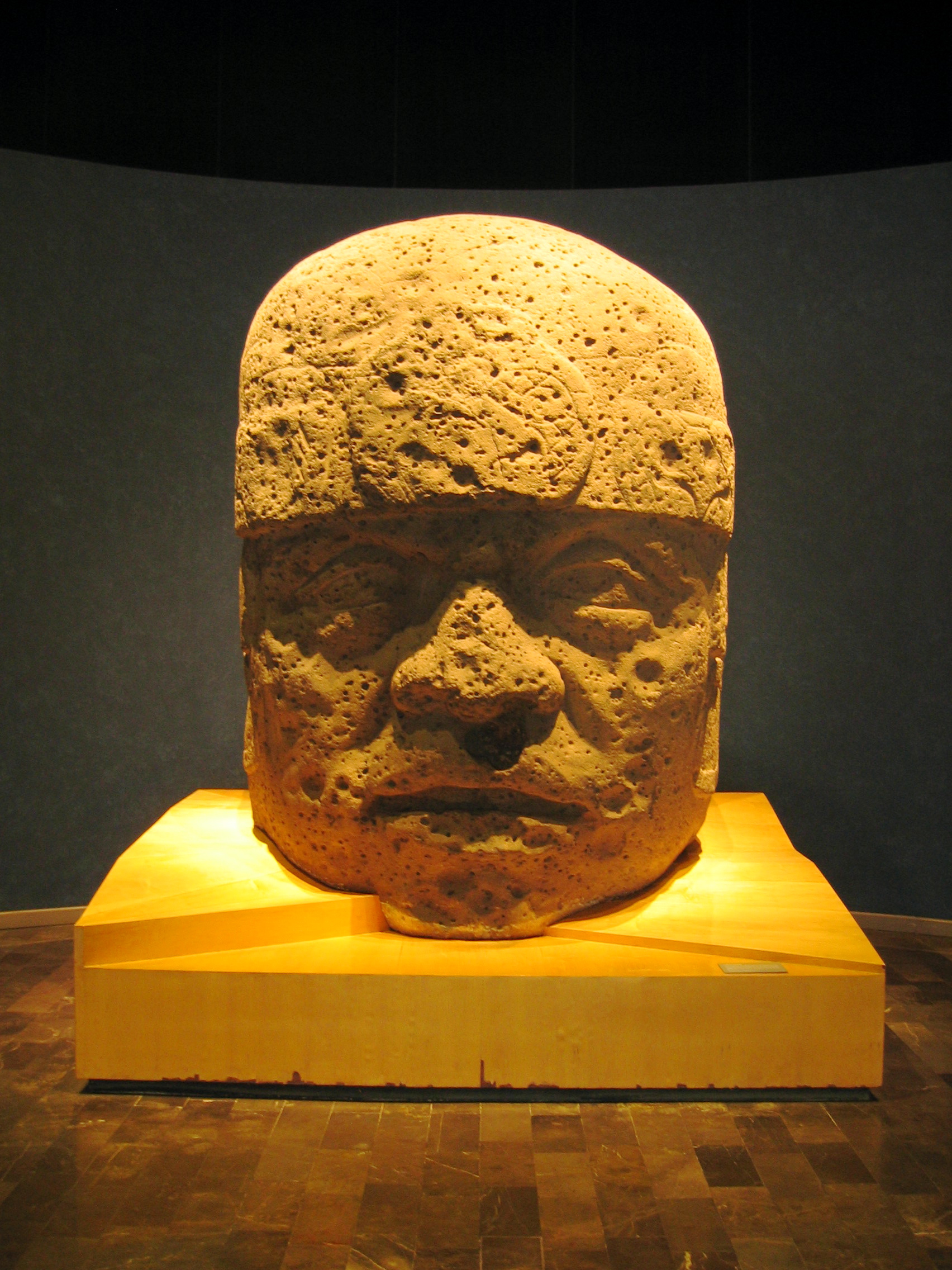
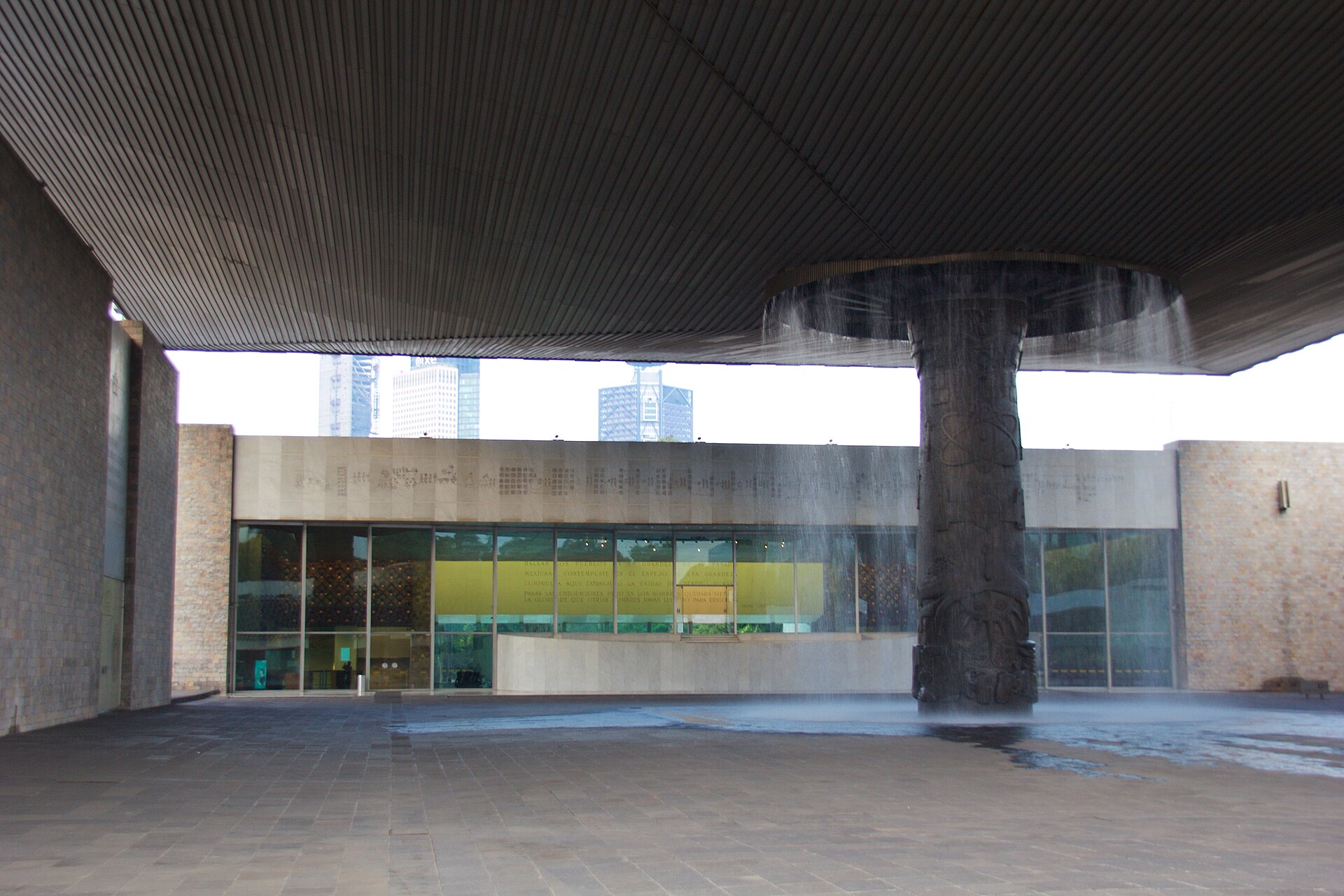
Most museums ask you to admire objects behind glass. The Museo Nacional de Antropología starts by making you look up. Part of its central courtyard is sheltered by a single concrete canopy, El Paraguas, balanced on one bronze-clad column with water falling from its rim, and the halls open off the courtyard around it. Inside them are the Aztec Sun Stone, the colossal Coatlicue, Olmec heads carved from boulders, a reproduction of a Maya king’s tomb and, upstairs, the living cultures of Mexico’s indigenous peoples. INAH counted just over five million visitors in 2025. Buying National Museum of Anthropology Mexico City tickets is the easy part: entry is 210 pesos for a foreign visitor in 2026, sold at the door and online. The harder part is knowing that Sunday is not free for visitors, that the museum shuts on Mondays, that you cannot see it all in one go, and which halls to choose when you only have a morning. This guide covers all of that, with a timed route, the rules at the door and what else to see nearby.
For the city’s other museums and how to fit them into a week, see our guide to the best museums in Mexico City. This page is about the Antropología alone.
The short answer
- Price: 210 pesos for a foreign visitor in 2026; 105 for Mexican nationals and foreign residents with proof; free for children under 13.
- Sundays: free only for Mexican nationals and foreign residents. A visitor pays the full 210 pesos.
- Hours: Tuesday to Sunday, 09:00 to 18:00. Closed on Mondays.
- Tickets: at the ticket office on the day, or online through INAH’s own ticketing site. No timed slot is needed.
- How long: three hours for a good first visit; a full day if archaeology is your thing.
- Where to start if you are short of time: the Mexica hall at the far end of the courtyard, for the Sun Stone and Coatlicue.
- Getting there: on Paseo de la Reforma in the Bosque de Chapultepec; the nearest Metro stations are Auditorio on Line 7 and Chapultepec on Line 1.
- Pair it with: Chapultepec Castle in the afternoon, or the Museo Tamayo across the gardens.
Your visit at a glance
| Where | Paseo de la Reforma at Calzada Gandhi, in the first section of the Bosque de Chapultepec |
| Open | Tuesday to Sunday, 09:00 to 18:00; closed on Mondays |
| Foreign visitor | 210 pesos in 2026, every day including Sunday |
| Mexican nationals and foreign residents | 105 pesos with proof; free on Sundays |
| Free entry | Under-13s; students, teachers, interns and authorised researchers with credentials; INAPAM card holders; certified guides at work |
| Tickets | At the ticket office, or online at INAH’s own ticket site |
| Nearest Metro | Auditorio (Line 7) and Chapultepec (Line 1) |
| Time needed | 90 minutes for the essentials, three hours for a good visit, a day for both floors |
| Facilities | Cloakroom, information module, audio guides, restaurant, snack bar, shop, library, parking and bicycle parking |
Tickets: who pays what
The Antropología is run by INAH, Mexico’s national institute of anthropology and history, and its prices are set nationally. INAH’s own bulletin of 6 January 2026 set the 2026 tariff:
| Visitor | Price in 2026 | What to bring |
|---|---|---|
| Foreign visitor | 210 pesos | Nothing extra |
| Mexican national or foreign resident | 105 pesos (half price) | Proof of nationality or residence |
| Children under 13 | Free | Proof of age, if asked |
| Students, teachers, interns and researchers | Free | Valid credentials; researchers need INAH authorisation |
| Over-60s | Free | An INAPAM card, Mexico’s seniors’ card |
| Tourist guides certified by Mexico’s tourism ministry | Free, while working | Their certification |
Two points trip people up. First, the Sunday rule: the museum is free on Sundays only for Mexican nationals and foreign residents. Plenty of older guides still tell visitors that Sunday is free for everyone; at INAH sites it is not, and a tourist pays 210 pesos on a Sunday like any other day. Second, the free categories are written for Mexican documents. The over-60s concession, for example, runs on the INAPAM card, which visitors do not have. If you hold a foreign student or teacher card, ask at the desk whether it is accepted rather than counting on it.
Buying online, and the fallback
The museum’s page on INAH’s places directory links to INAH’s own ticket site, ventadeboletosenlinea.inah.gob.mx. Buying there saves the ticket-office queue on a busy day, and it is the only online seller to use: tickets are not something to buy from a reseller with a mark-up. There is no timed-entry system to book. If the website misbehaves, the ticket office at the museum sells the same ticket on the day.
INAH revises its tariffs every January, so a visit in 2027 should be checked against the new figures.
Hours, closures and the 2026 works
- Open: Tuesday to Sunday, 09:00 to 18:00, according to INAH’s listing.
- Closed: every Monday. If your trip includes a Monday, spend it at Teotihuacán, which opens every day, and keep the Antropología for another day.
- Holidays: check INAH’s announcements before planning a visit on 25 December or 1 January, or on any other public holiday.
- Renovation: INAH’s May 2026 bulletin described a renovation programme of more than 40 million pesos across 2025 and 2026. The first phase, from September to December 2025, waterproofed the ethnography halls and the Paraguas. A second phase began in March 2026, covering the marble platforms, the bronze access to the Mexica hall, the water mirror and new glass doors to the garden of the Oaxaca hall, with INAH expecting the work to finish at the end of May 2026. A particular hall or garden can still be closed for maintenance on the day, so check INAH’s announcements if one is a priority.
When to go: days, times and crowds
With more than five million visitors a year, the Antropología is rarely empty, but the difference between a good and a bad hour is large.
- Best: a weekday morning, from 09:00. Tuesday to Friday at opening time gives you the Mexica hall at its quietest. School groups are part of the museum’s life on weekdays, so if one arrives in the hall you are in, move on and come back.
- Busier: Saturdays and Sundays. Sunday is the free day for Mexican families, which makes it lively and crowded, and it is no cheaper for a visitor. A Saturday morning is the better weekend choice.
- Avoid: the last two hours. Arriving after 16:00 leaves too little time for a museum this size.
- In the rainy season, roughly May to October, afternoon storms make the museum an excellent wet-weather plan. Do the park or the Castle’s terraces in the morning and come here after lunch, leaving at least two hours before closing.
- In December, holiday crowds and public holidays change the pattern; check INAH’s announcements for the days around Christmas and New Year.
Who should visit, and how long to allow
Almost everyone. This is not a specialist museum for people who already love archaeology; it is the clearest introduction there is to who lived in Mexico before the Spanish arrived and who lives here now. A few kinds of visitor will get the most out of it:
- First-time visitors to Mexico. Give it a morning early in the trip and every pyramid, market and mural afterwards makes more sense.
- Anyone going to Teotihuacán. Visit the museum first. The Teotihuacán hall turns the site from a field of stone into a city.
- Families. Children under 13 enter free, the courtyard gives them room to run between halls, and the scale of the stone heads and the Sun Stone works on any age.
- People with only one museum day. If you will see one museum in Mexico City, make it this one.
As for time: 90 minutes covers the essentials in a hurry, three hours is a satisfying first visit, and a full day with a lunch break is what it takes to see both floors properly. Few people manage the whole museum in one visit, and nobody should try to. Arrive at 09:00 if you can; the first hour is the calmest.
With children
Under-13s enter free, which makes this one of the cheaper big days out for a family. The objects that work best on children are the big ones: the Olmec heads, Coatlicue, the Sun Stone and the curtain of water falling from the Paraguas. Keep the visit to two hours, build it around three or four of those, and use the courtyard for breaks between halls. Our Mexico City with kids guide covers the rest of a family trip.
The building
The museum opened on 17 September 1964, inaugurated by President Adolfo López Mateos, in a building designed by the architect Pedro Ramírez Vázquez with Rafael Mijares and Jorge Campuzano. The institution itself is older: INAH traces it to the Museo Nacional de México, founded in 1825 after independence, whose bicentenary the Antropología marked with an exhibition in 2025.
Its centrepiece is the courtyard and El Paraguas, “the umbrella”, a concrete canopy roughly 84 by 54 metres resting on a single column. The column is wrapped in bronze reliefs by José Chávez Morado, and water pours from the rim of the canopy in a curtain around it. On the upper floor, the lattice screen facing the courtyard, a geometric serpent in anodised aluminium, is by Manuel Felguérez. Out on Paseo de la Reforma, the huge stone Monolito de Tláloc, the rain god, guards the entrance; look for it as you arrive.
The building holds 22 permanent halls, two halls for temporary exhibitions and three auditoriums, and it houses the national library of anthropology and history. Murals by José Chávez Morado, Jorge González Camarena and Iker Larrauri decorate the introductory hall, Sala Orígenes.
Where the collection came from
The building is from 1964, but the collection is far older, and its story explains why the best-known Aztec sculptures ended up on Paseo de la Reforma.
- The late eighteenth century. The colonial authorities deposited documents from the antiquarian Lorenzo Boturini’s collection at the Royal and Pontifical University of Mexico, and the Coatlicue was kept there too. That, by most accounts, is where Mexico’s tradition of public museums begins.
- 1825. A few years after independence, a decree by President Guadalupe Victoria created the Museo Nacional Mexicano, gathering historical, archaeological and ethnographic pieces as a national collection. INAH treats this museum as the institution the Antropología grew from, and marked its bicentenary with an exhibition in 2025.
- 1865. Emperor Maximilian moved the museum into the old Casa de Moneda, the former mint on Calle Moneda in the Centro, a few steps from the Zócalo.
- 1910 to 1940. As the collections grew they were divided, natural history going elsewhere, and the museum became the Museo Nacional de Arqueología, Historia y Etnografía.
- 1940. In December 1940 the history collections were moved up the hill to Chapultepec Castle, which became the Museo Nacional de Historia. The archaeological pieces stayed at the old mint.
- 1964. The present building opened in the Bosque de Chapultepec and the great monoliths made their last move.
So the Castle and the Antropología, the two museums most visitors see on the same day, are two halves of what was once a single national museum.
Who came when: a five-minute primer
The ground floor is easier to enjoy with a rough timeline in your head. You do not need dates, just the order.
- The Olmecs, on the Gulf Coast, are the earliest of the great cultures in the museum, and the colossal heads are theirs.
- Teotihuacán, just north of the modern capital, grew into one of the largest cities of the ancient Americas, while the Maya built their own kingdoms in the south-east.
- The Toltecs and their contemporaries filled the space left when Teotihuacán fell; Tula, with its stone warriors, is theirs.
- The Mexica came last, founding Tenochtitlan on an island in the lake that once filled this valley and ruling much of central Mexico until the Spanish conquest.
- In Oaxaca, the Zapotecs and later the Mixtecs run alongside much of that story, which is why their hall comes after the chronological sequence and starts the regional one.
Upstairs, the story continues to the present, with the descendants of many of these peoples living in the same regions today.
The highlights, hall by hall
The ground floor is archaeology. The halls run around the courtyard in chronological order, starting on the right as you enter and arriving at the Mexica hall at the far end; from the Oaxaca hall onwards they are arranged by region. The upper floor is ethnography: the indigenous peoples of Mexico today, their dress, crafts, homes and festivals.
The opening halls
The introduction to anthropology and the halls on the peopling of the Americas and the Preclassic set the scene. They are worth half an hour on a long visit and a brisk walk-through on a short one.
Teotihuacán (Sala 4)
The great city an hour north of the capital, built and rebuilt over centuries. Its hall is the one to see before you visit the site itself: the models, the monumental sculpture of the water gods and the reconstructed temple architecture give the ruins a scale and a colour that the bare stone has lost. Our Teotihuacán guide covers the visit.
The Toltecs and the Epiclassic (Sala 5)
The cities that rose after Teotihuacán fell, among them Tula, represented here by one of its towering stone warrior columns, the Atlantes, and Cacaxtla, with a reproduction of one of its painted murals.
The Mexica hall (Sala 6)
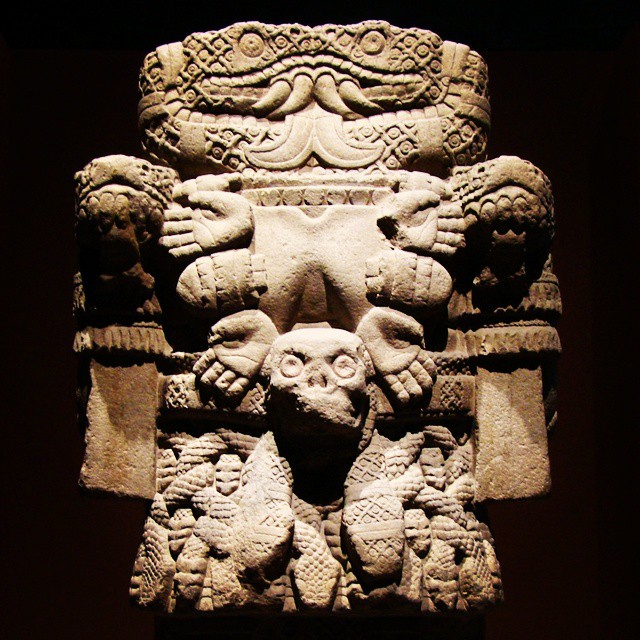
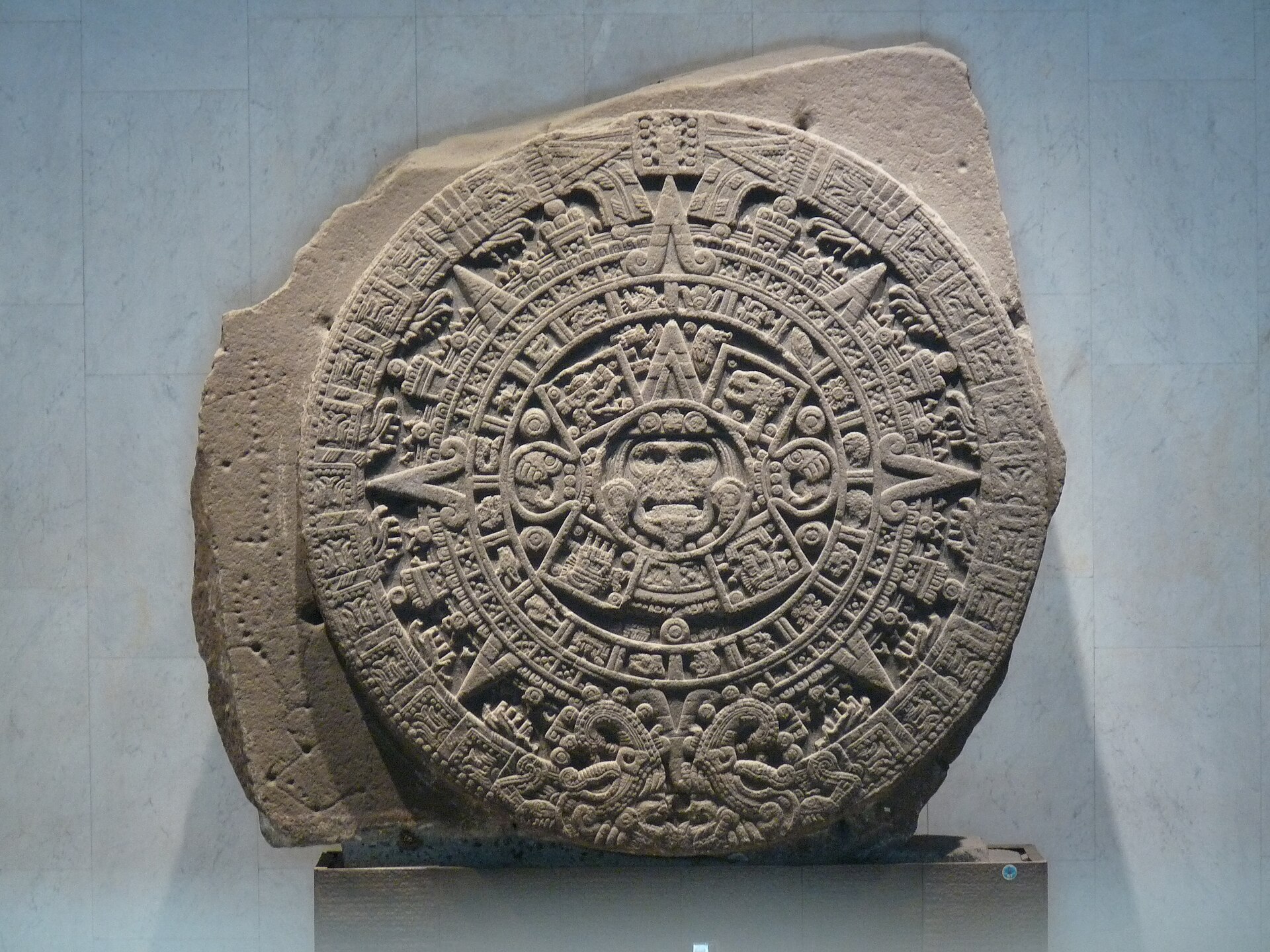
The heart of the museum, at the far end of the courtyard, and the hall to see if you see nothing else. The Mexica were the people Europeans called the Aztecs, and their capital, Tenochtitlan, lies under the modern city centre. Here are the Piedra del Sol, the Sun Stone, the carved basalt disc that has become a national symbol; the colossal Coatlicue, with a pair of serpent heads where her head should be and a necklace of hands and hearts; the Piedra de Tízoc, carved with the conquests of a ruler; and smaller marvels such as an obsidian vessel in the shape of a monkey. If you saw the Templo Mayor’s ruins in the Centro, this is where the story they belong to is told.
Oaxaca (Sala 7)
The Zapotec and Mixtec cultures of the south, from the hilltop city of Monte Albán, with its funerary offerings and its gods in clay and stone.
The Gulf Coast (Sala 8)
The cultures of Veracruz and Tabasco, above all the Olmecs, whose colossal heads, carved from single boulders, are among the most striking objects in the museum. Stand in front of one and the photographs suddenly seem very small.
The Maya hall
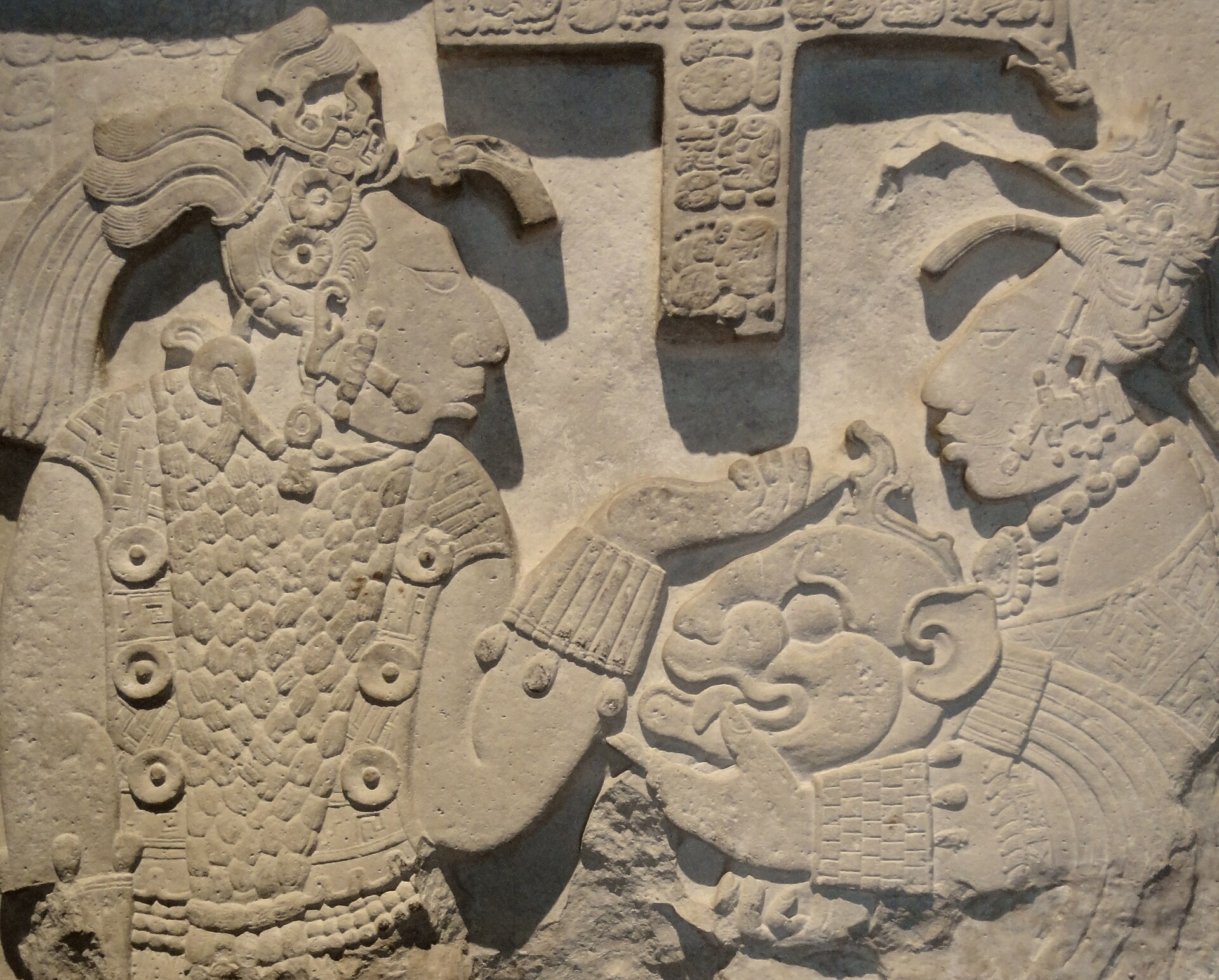
Carved lintels and stelae from the Maya cities of the south-east, and the museum’s other must-see: the reproduction of the tomb of Pakal, the ruler of Palenque, with his jade funerary mask, assembled from some two hundred pieces of jade. INAH lists the mask among the museum’s most important pieces.
The north and the west
The halls on the cultures of northern Mexico, the desert peoples of what is often called Aridoamérica, and of the western states complete the ground floor. They are quieter than the famous halls and rewarding if you have the time.
The upper floor: Mexico’s indigenous peoples today
Most visitors run out of energy before they climb the stairs, which is a pity. The ethnography halls show the dress, homes, crafts, music and festivals of the indigenous peoples of modern Mexico, region by region, and they answer a question the ground floor raises: what happened to the people who built all this? They are still here. Even twenty minutes upstairs changes how you read the rest of the trip.
The temporary exhibitions
Alongside the permanent halls, the museum runs two halls of temporary exhibitions, often with loans from abroad. In 2025, INAH notes, they included Sebastião Salgado’s photographic exhibition Amazonía and a show marking the bicentenary of the Museo Nacional de México. Whether the current show is worth your time depends on what is on, so look at the museum’s programme before you go. On a short visit, the permanent collection comes first; the temporary halls are for a second visit or a long day.
Timed routes through the museum
If you have 90 minutes
- Walk straight across the courtyard to the Mexica hall: the Sun Stone, Coatlicue and the Piedra de Tízoc. Forty minutes.
- Go next door to Teotihuacán, especially if the pyramids are on your itinerary. Twenty minutes.
- Cross to the Gulf Coast hall for an Olmec head, then the Maya hall for Pakal’s tomb. Thirty minutes.
If you have a morning (about three hours)
- Start on the right of the courtyard and walk the ground floor in order: the opening halls briskly, then Teotihuacán, the Toltecs and the Mexica hall at leisure.
- Take a break in the courtyard under the Paraguas.
- Continue through Oaxaca, the Gulf Coast and the Maya hall.
- Finish with twenty minutes upstairs in the ethnography halls above whichever region you liked best.
If you have a whole day
- Morning: the ground floor in full, in order.
- Lunch at the museum or in Polanco, a short walk north across Reforma.
- Afternoon: the upper floor, region by region, then the temporary exhibition if it appeals.
- Late afternoon: a walk in the Bosque de Chapultepec, or across the gardens to the Museo Tamayo.
Mistakes to avoid
- Turning up on a Monday. The museum is closed. Check the day before you cross the city.
- Assuming Sunday is free. It is for Mexican nationals and residents, not for visitors, and it is often the busiest day.
- Arriving at 16:00. The museum closes at 18:00. Two hours is enough for the essentials and no more.
- Trying to see everything. Twenty-two halls in one visit means seeing none of them properly. Choose, and come back.
- Skipping the upper floor. Even twenty minutes in the ethnography halls changes how you read the rest of the trip.
- Leaving the Castle until late. If you are pairing the two, remember that the Castle closes an hour earlier, at 17:00.
- Buying from resellers. The only online seller you need is INAH’s own ticket site.
- Not allowing for the door. Security, the cloakroom and the ticket queue can take a while on a busy day; build in a buffer.
Bags, photography and the rules at the door
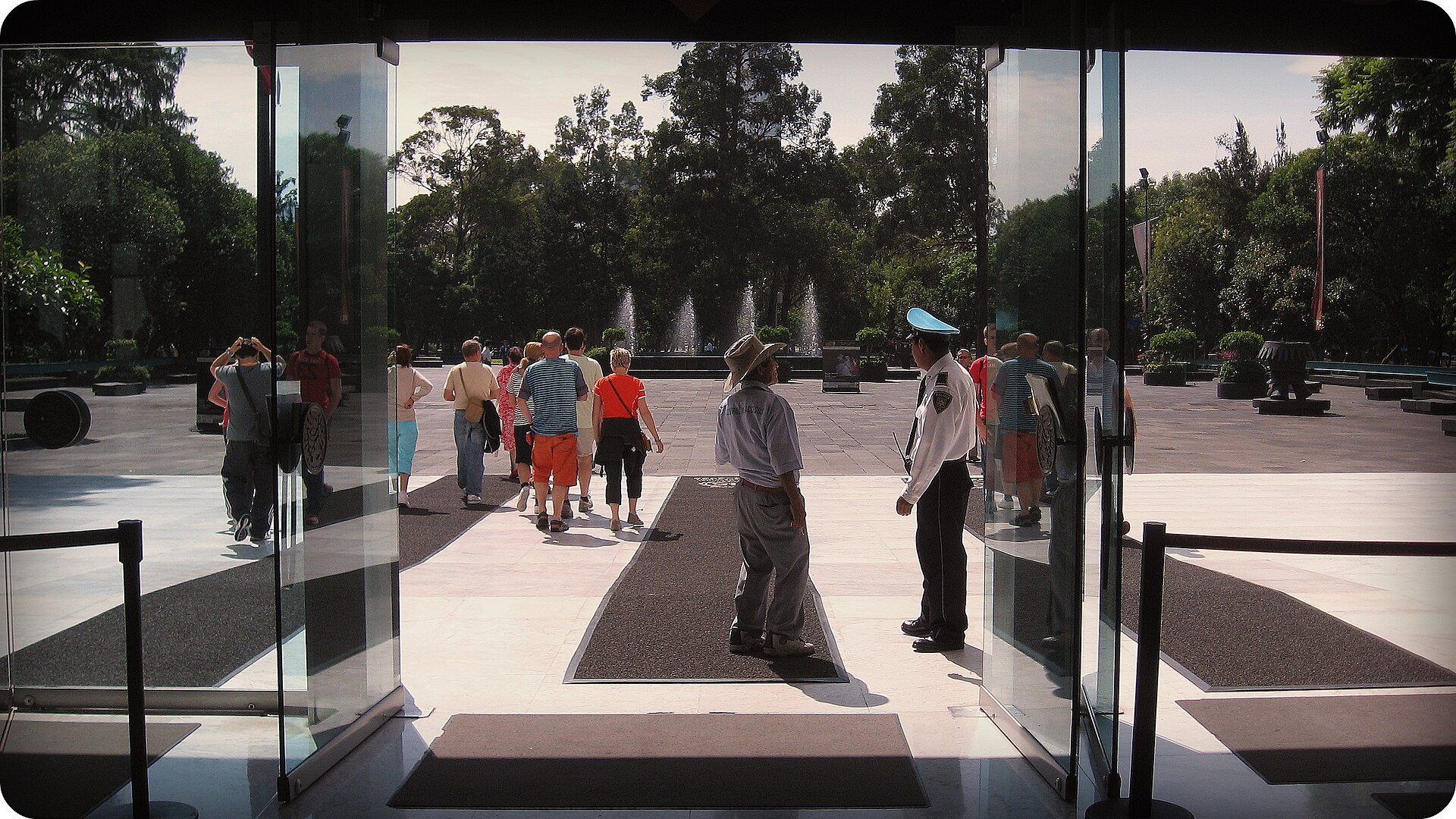
INAH lists a cloakroom, an information module, audio guides, a library, a shop, a restaurant, a snack bar, parking, bicycle parking and accessibility services among the museum’s facilities. Door rules change, so treat the following as advice rather than law:
- Travel light. Large bags and backpacks may have to go to the cloakroom, and you will enjoy two floors of halls more without one.
- Ask about photography at the information module. Rules on tripods, video and professional cameras can differ from the rules for a phone, so ask whether a permit is needed before you film. Never use flash on the exhibits.
- Bring some cash for the cloakroom, a permit or a coffee, in case a card machine is down.
- Food and drink stay outside the halls; use the snack bar or the restaurant.
- Accessibility: the ground floor is laid out around a level courtyard, and INAH lists accessibility among the museum’s services. Ask at the information module about the lifts to the upper floor and about borrowing a wheelchair, and plan a route that keeps to the ground floor if stairs are a problem; the archaeology halls, which most visitors come for, are all down there.
Eating at the museum
INAH lists both a restaurant and a snack bar inside the museum, which makes a full-day visit easy: break for lunch between the two floors without leaving. If you would rather eat outside, Polanco’s restaurants are a short walk north across Paseo de la Reforma, and our food guide has ideas. Do not plan a picnic in the halls.
Getting there
- Address: Paseo de la Reforma at Calzada Gandhi, Colonia Chapultepec Polanco, in the first section of the Bosque de Chapultepec.
- Metro: the nearest stations are Auditorio on Line 7 and Chapultepec on Line 1. INAH puts the walk from the stations at about 1.3 kilometres, through or alongside the park.
- App ride or taxi: the simplest option from Roma, Condesa or the Centro, and it drops you at the entrance on Reforma.
- On a Sunday morning, Paseo de la Reforma is usually part of the Sunday-morning cycling route (Muévete en Bici, 08:00 to 14:00), which can complicate a drop-off at the front; walk the last stretch or come by Metro.
- Combine it with the park. Chapultepec Castle stands on the hill across Reforma from the museum, a walk through the park and up the slope.
Our getting around guide covers the Metro and the alternatives.
Nearby alternatives, and what to pair it with
- Chapultepec Castle and the Museo Nacional de Historia. On the hill in the same park, also run by INAH, Tuesday to Sunday from 09:00 to 17:00, and 210 pesos for a foreign visitor in 2026. The natural afternoon after a morning at the Antropología, with views down Reforma from the terraces. Mind the earlier closing time.
- Museo Tamayo. A modern and contemporary art museum across the gardens, open Tuesday to Sunday from 10:00 to 18:00, closed on Mondays and free on Sundays. Check its website before you go, because exhibition changeovers sometimes close it for a few days.
- Museo de Arte Moderno. Also in the park, and the home of Frida Kahlo’s Las dos Fridas. Check its current hours and prices on its own site.
- The Bosque de Chapultepec itself. The lake, the paths and the newer sections reached by the Cablebús. Our parks and outdoors guide covers it.
- On a Monday, when the Antropología is closed, go to Teotihuacán instead; the site opens every day.
For how the Antropología fits into a longer trip, see our 3 days in Mexico City itinerary, which puts it on day two, and the wider itineraries guide.
Frequently asked questions
How much are National Museum of Anthropology tickets in 2026?
210 pesos for a foreign visitor, 105 for Mexican nationals and foreign residents with proof, and free for children under 13, according to INAH’s 2026 tariff. Students, teachers and INAPAM card holders also enter free.
Is the National Museum of Anthropology free on Sundays?
Only for Mexican nationals and foreign residents. A foreign visitor pays the full 210 pesos on a Sunday.
Do I need to book tickets in advance?
No. There is no timed-entry system. You can buy at the ticket office on the day or online through INAH’s own ticket site, which saves queuing on a busy day.
What days is the museum closed?
Mondays. It opens Tuesday to Sunday from 09:00 to 18:00. Check INAH’s announcements before a visit on a public holiday such as 25 December or 1 January.
How long do I need at the Museo Nacional de Antropología?
Three hours for a good first visit, 90 minutes for the essentials in a hurry, and a full day to see both floors properly.
What should I not miss?
The Mexica hall, for the Sun Stone and Coatlicue; the Teotihuacán hall, especially before visiting the pyramids; an Olmec colossal head in the Gulf Coast hall; Pakal’s tomb and jade mask in the Maya hall; and El Paraguas in the courtyard.
How do I get to the museum by Metro?
Take Line 7 to Auditorio or Line 1 to Chapultepec. INAH puts the walk from the stations at about 1.3 kilometres. An app ride to the entrance on Paseo de la Reforma is the easiest alternative.
Can I visit the museum and Chapultepec Castle on the same day?
Yes, and it is the classic pairing. Do the museum in the morning and the Castle after lunch, remembering that the Castle closes at 17:00 and that both are closed on Mondays.
Is there somewhere to eat inside the museum?
Yes. INAH lists a restaurant and a snack bar among the museum’s services, so you can break for lunch without leaving. Polanco’s restaurants are also a short walk away.
Can I take photographs in the museum?
Ask at the information module about the current rules, especially for video, tripods and professional cameras, and never use flash on the exhibits.
If you are making a Chapultepec day of it, our Chapultepec Castle tickets and visitor guide covers the afternoon half: the 2026 prices, the earlier 17:00 closing, the walk up the hill and what to see in the Alcázar and the history museum.
If Sunday was going to be your free museum day, see our guide to free things to do in Mexico City: the Bellas Artes museum and the Museo Tamayo list Sunday as free, and the Museo Soumaya and the Museo Jumex in Polanco don’t charge at all.
Related Mexico City Guides
- The best museums in Mexico City, and how to plan a museum week around the Monday closures.
- Frida Kahlo Museum tickets, a museum where booking ahead matters.
- Teotihuacán, the site the museum’s fourth hall prepares you for.
- Parks and outdoors, including the Bosque de Chapultepec.
- Mexico City itineraries and Mexico City with kids.
- Getting around and costs.
Sources and verification
Prices, hours and facilities were checked in November 2026 against INAH’s own publications:
- INAH, Boletín No. 6 of 6 January 2026: the 2026 tariff, exemptions and Sunday rule, and the 2025 visitor figure. inah.gob.mx
- INAH places directory, Museo Nacional de Antropología: hours, prices, services, address, nearest Metro stations and the online ticket link. lugares.inah.gob.mx
- INAH places directory, the museum’s history and principal pieces. lugares.inah.gob.mx
- INAH, Boletín No. 187 of 4 May 2026: the 2025-2026 renovation. inah.gob.mx
- INAH’s online ticket site. ventadeboletosenlinea.inah.gob.mx
- The building, its architects and the hall layout. Wikipedia (Spanish)
- Museo Tamayo, visitor information. museotamayo.org
INAH revises its tariffs every January and announces holiday closures separately. Check the museum’s INAH listing before you go.
Photo Credits
Olmec colossal head from San Lorenzo: Olmec Head from San Lorenzo, Veracruz by rosemania, CC BY 2.0, via Wikimedia Commons.
El Paraguas, the museum courtyard: photo by Mike Peel, CC BY-SA 4.0, via Wikimedia Commons.
Coatlicue: Diosa Coatlicue by J Mndz, CC BY-SA 2.0, via Wikimedia Commons.
Lintel 26 from Yaxchilán: Dintel 26 de Yaxchilán – Museo Nacional de Antropología – Sala 9 – Mayas by Juan Carlos Fonseca Mata, CC BY-SA 4.0, via Wikimedia Commons.
The Sun Stone: Monolito de la Piedra del Sol by El Comandante, CC BY-SA 3.0, via Wikimedia Commons.
The main entrance: Main entrance from inside, National Anthropology Museum by 16:9clue, CC BY 2.0, via Wikimedia Commons.